

GEORGIAN TEST WITH HEAVY TRUCKS
What is behind Tbilisi's new transit policy against Azerbaijan?

Author: Natig NAZIMOGHLU
In recent weeks, relations between Baku and Tbilisi have been overshadowed by artificial obstacles created for the movement of Azerbaijani trucks along the transit route through Georgia. This has raised a range of possible reasons for the behaviour of the Georgian authorities, which in fact provoke tension in the friendly and neighbourly relations between the two countries.
The problem remains
The issue is attributable to delays experienced at Georgian customs checkpoints for trucks transporting goods from Azerbaijan to Europe. Furthermore, these delays have not been accompanied by any official explanations. Azerbaijani truck drivers have raised concerns about the length of the necessary documentation procedures, which they feel are unjustified, and about the lack of courtesy from Georgian customs officers.
These facts suggest that Georgia is abusing its transit position, the benefits of which have largely been built thanks to Azerbaijani investments and, most importantly, major economic and infrastructural projects implemented in the region with active participation and even leadership from Baku.
However, the Prime Minister of Georgia, Irakli Kobakhidze, has attempted to refute this claim by stating that there have been no such delays. Meanwhile, the Revenue Service of Georgia's Ministry of Finance linked the situation at customs to the fact that "with the increase in freight traffic, all customs procedures for vehicles involved in international transportation are carried out in a particularly active mode." To summarise, the assertion is that the issue is exclusively of a technical nature.
However, such a superficial assessment, coupled with the Georgian authorities' reluctance to address the issue rather than merely deflecting it, has the potential to exacerbate tensions. The question becomes even more pertinent: what are the reasons behind Tbilisi's decision to take actions that could potentially hinder strategic dialogue with Baku? This is particularly concerning when such actions are clearly at odds with Georgia's long-term interests in maintaining its reputation as a reliable transit country.
Thoughts about Zangezur
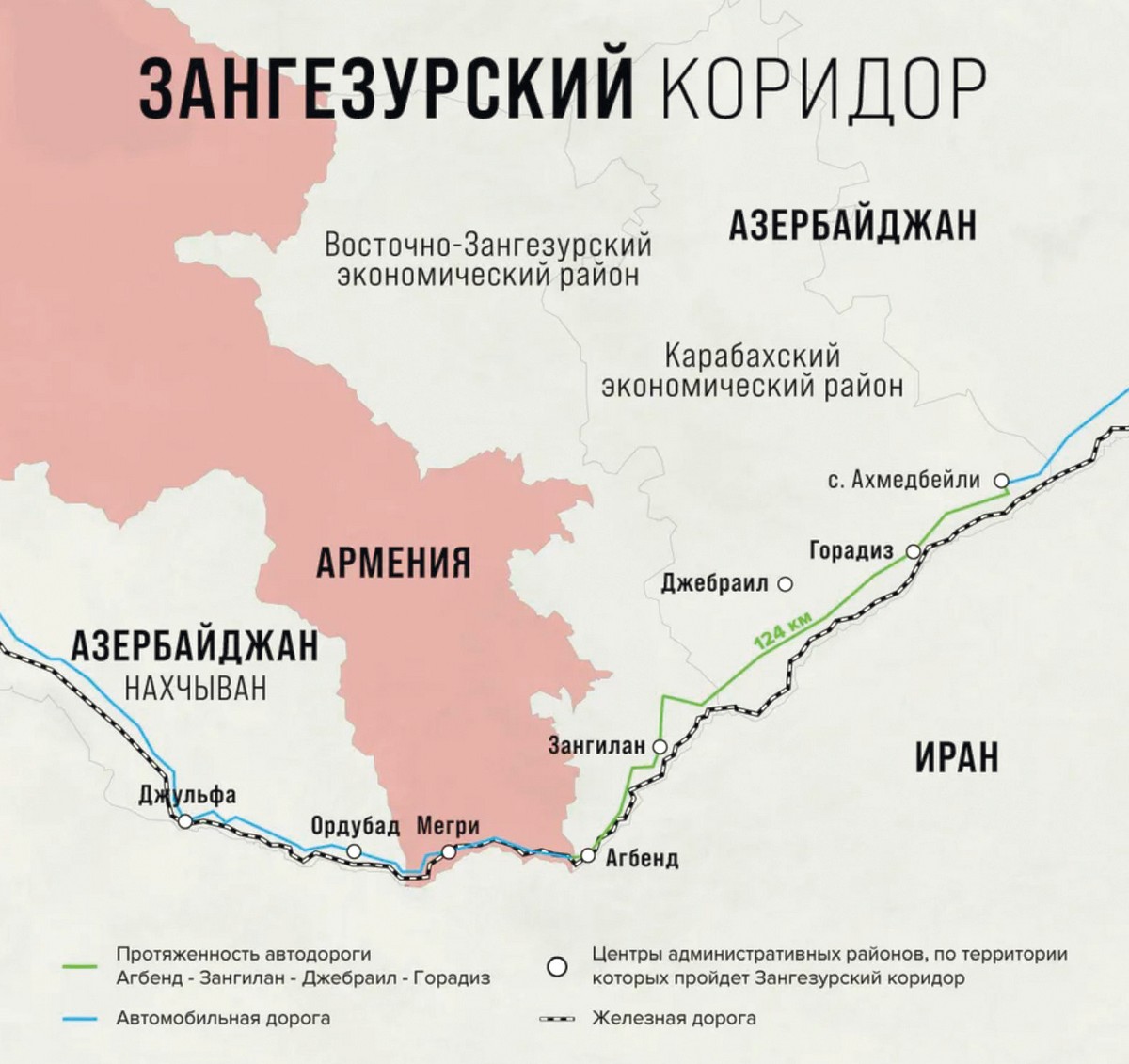
A key reason for the obstacles created by Georgian customs officers is said to be Tbilisi's concern over the prospects of implementing the Zangezur corridor. This is evidenced by the remarks made by Azerbaijani drivers, who have reported that when voicing concerns regarding delays in cargo processing, Georgian customs officials have made unprofessional suggestions, such as "going through Zangezur."
The Georgian side's actions are driven by the understanding that facilitating regional communications is a crucial step in the successful resolution of Azerbaijani-Armenian relations. The establishment of a direct transport connection between Azerbaijan and Armenia is regarded as a potential resolution to the ongoing situation during the Karabakh conflict period, when Georgia assumed the exclusive transit role for goods from Azerbaijan, travelling westward, and from Armenia, travelling westward and northward.
It is also noteworthy that obstacles created by Georgian customs and police on goods moving from Azerbaijan to Europe significantly increased after the signing on 8 August in Washington of the TRIPP agreement — "Trump Route for International Peace and Prosperity." The creation of the Zangezur corridor transitioned from theoretical to practical when it became a project based on a strategic decision and political will by Azerbaijan, Armenia, and the US.
An "order" for Georgian Dream
The position of the US is an important factor in another possible explanation for Georgia's tougher customs practices regarding Azerbaijani heavy trucks crossing its territory. This is due to the significant discontent in Tbilisi regarding the recent changes to Georgia-related policy by the United States and European Union.
Dialogue between Tbilisi and the West has practically entered a crisis phase amid accusations by Washington and Brussels that the "Georgian Dream" government, effectively led by billionaire Bidzina Ivanishvili, pursues a pro-Russian policy. Tbilisi has formally denied these claims, yet it is important to note that criticism of the Georgian authorities continues to be voiced not only from Europe but also from the United States. Despite the return of Donald Trump to the White House, there are no indications of improvement in US-Georgia relations, which were recently regarded as a partnership and even an alliance. It is evident that the Georgian leadership is concerned about this fact, while also expressing enthusiasm for the American focus on Azerbaijan and Armenia, as well as their peace, within the Trump administration's South Caucasus policy.
In this context, the development of "special relations" between Georgia and Russia emerges as a potential explanation for many seemingly illogical actions by the Georgian leadership. In particular, there is a notable increase in customs pressure on goods moving from Azerbaijan westward through Georgian territory.
This concept is endorsed by numerous Georgian specialists. For instance, Gela Vasadze has stated that "Moscow decided to use Georgia as a tool against Azerbaijan." Former Georgian President Mikhail Saakashvili, currently imprisoned, has criticised official Tbilisi for creating problems with cargo movement for Azerbaijan. This supports the view that the current situation is the result of an order from Moscow.
Russia's potential interest in creating problems in Azerbaijani-Georgian relations can be explained by its dissatisfaction with the new regional reality shaped primarily by Azerbaijan's efforts — the leading state in the South Caucasus. However, regardless of whether Georgia's authorities' key motive is "Zangezur," "American," "Russian," or something else entirely, it is clear that tension in relations with Azerbaijan is not in Georgia's interest. Furthermore, it would be illogical for Georgia to expect that tightening administrative measures on transport communications could weaken Baku's growing regional influence.
Baku, Tbilisi and the whole region
Azerbaijan has clearly stated that it continues to consider Georgia its strategic partner and good neighbour—a country it has supported extensively during its most critical periods. In the context of the August 2008 war and the subsequent Russian-Georgian confrontation, triggered by Moscow's recognition of the independence of the rebellious Georgian autonomous regions of Abkhazia and South Ossetia, this is also the case. Azerbaijan's friendly policy towards Georgia is demonstrated by the supply of Azerbaijani natural gas to Georgia at a preferential price. In accordance with the terms of a contract signed in 2008, the annual export of 500 million cubic metres of Azerbaijani gas is to be conducted "on special terms".
What implications could disruptive actions by Tbilisi have for the friendship between Azerbaijan and Georgia, given the increasingly realistic prospects of peace and effective cooperation among the South Caucasus states – Azerbaijan, Georgia, and Armenia? Despite the fact that the Zangezur corridor marks the end of an era in which Georgia had a monopoly on transit routes, it remains of great strategic benefit to the country. It has the potential to strengthen the political and economic sovereignty of the entire South Caucasus region and all the countries within it. Furthermore, it is evident that the Zangezur corridor will have a negative impact on Georgia's transit route, unless the Georgian authorities choose to undermine its reliability.
Azerbaijan's success in the Nagorno-Karabakh conflict has created a unique opportunity for the entire region to enjoy lasting peace and significant economic growth. By resolving a long-standing dispute with Armenia, Azerbaijan is enhancing the geostrategic significance of the South Caucasus region, while concurrently addressing various challenges that threaten its own interests and those of the region. Consequently, any actions or policies that are not aligned with this reality are likely to be unsuccessful. It is imperative that Georgian authorities take this into consideration and adapt their approach accordingly.
RECOMMEND:
 232
232

