

NO EXTERNAL RESCUE
Armenia's march through a dangerous electoral race

Author: NURANI
Election campaigns often effectively begin long before their official start dates. It is said they commence the moment the results of the previous plebiscite are tallied. While the victors celebrate and plot how to repeat their success, the defeated conduct a "post-mortem" of their errors and prepare for a rematch.
In Armenia, parliamentary elections are scheduled for June 2026. A constitutional referendum will likely take place simultaneously, though Yerevan hints it might be postponed. Meanwhile, electoral passions are already flaring. This is not merely about forming political blocs or negotiating inter-party coalitions; the political field in Armenia is already carved up. The opposition is preparing to give a "decisive battle" to the incumbent Prime Minister and his Civil Contract party. Nikol Pashinyan, in turn, intends to consolidate his position.
Losing in Garabagh, winning in Armenia
Theoretically, it is difficult to count on victory in parliamentary elections after losing two wars. Nevertheless, Pashinyan has managed to retain power. While Serzh Sargsyan and the entire Garabagh Clan were toppled by the Velvet Revolution (often mocked by critics as the "barbecue revolution") just two years after the battles for Lele Tepe, Nikol Pashinyan defied forecasts in 2021. Following the 44-day war, he won the elections—albeit under revanchist slogans, promising Armenian voters the return of Shusha and Hadrut.
Political platforms for the 2026 elections have not yet been published, but having initialed the agreement in Washington, Pashinyan cannot even theoretically promise to return the so-called Artsakh. He is already campaigning on the concept of "Real Armenia" as a counterweight to "Historical Armenia." It is not difficult to discern in this a call to recognize existing borders and renounce territorial claims against neighbours—primarily Türkiye and Azerbaijan.
At the same time, war fatigue is evident in Armenian society, alongside an understanding that attempts at revanchism could come at too high a price. Nor can one rely on external patrons to fight for Armenia and its territorial dreams. Domestic resources are theoretically insufficient to achieve even parity with Azerbaijan, let alone superiority. Thus, the incumbent Prime Minister is compelled, willy-nilly, to pursue a peace agenda.
Although a peace treaty has not yet been signed, Armenia is already reaping significant benefits. Grain—from Kazakhstan and Russia—is already being transported to Armenia through Azerbaijani territory. Next in line is diesel fuel. The Minister of Economy of Armenia meets the cargo trains personally, and Pashinyan shares the relevant information on social networks, thanking President of Azerbaijan Ilham Aliyev.
But does this mean the Prime Minister need not worry about the election outcome? Experts warn that no matter how severe the defeat in war, revanchist sentiments will persist in society. A classic example is Germany, where Hitler came to power on precisely such a wave after World War I. Even after World War II, revanchists there still make themselves known.
It is no accident that Nikol Pashinyan no longer relies heavily on his street popularity and is systematically clearing the political field. The mayor of Gyumri, Vardan Ghukasyan, and his deputy have been arrested. The government continues to methodically pressure the church. Pashinyan has already managed to split ecclesiastical circles and cobble together a coalition of archbishops ready to assist in the removal of Catholicos Karekin II.
However, it seems the Prime Minister and his supporters are more anxious about the possibility of external interference. Primarily from Russia. So much so that Yerevan has requested foreign support.
15 Million and "hybrid threats"
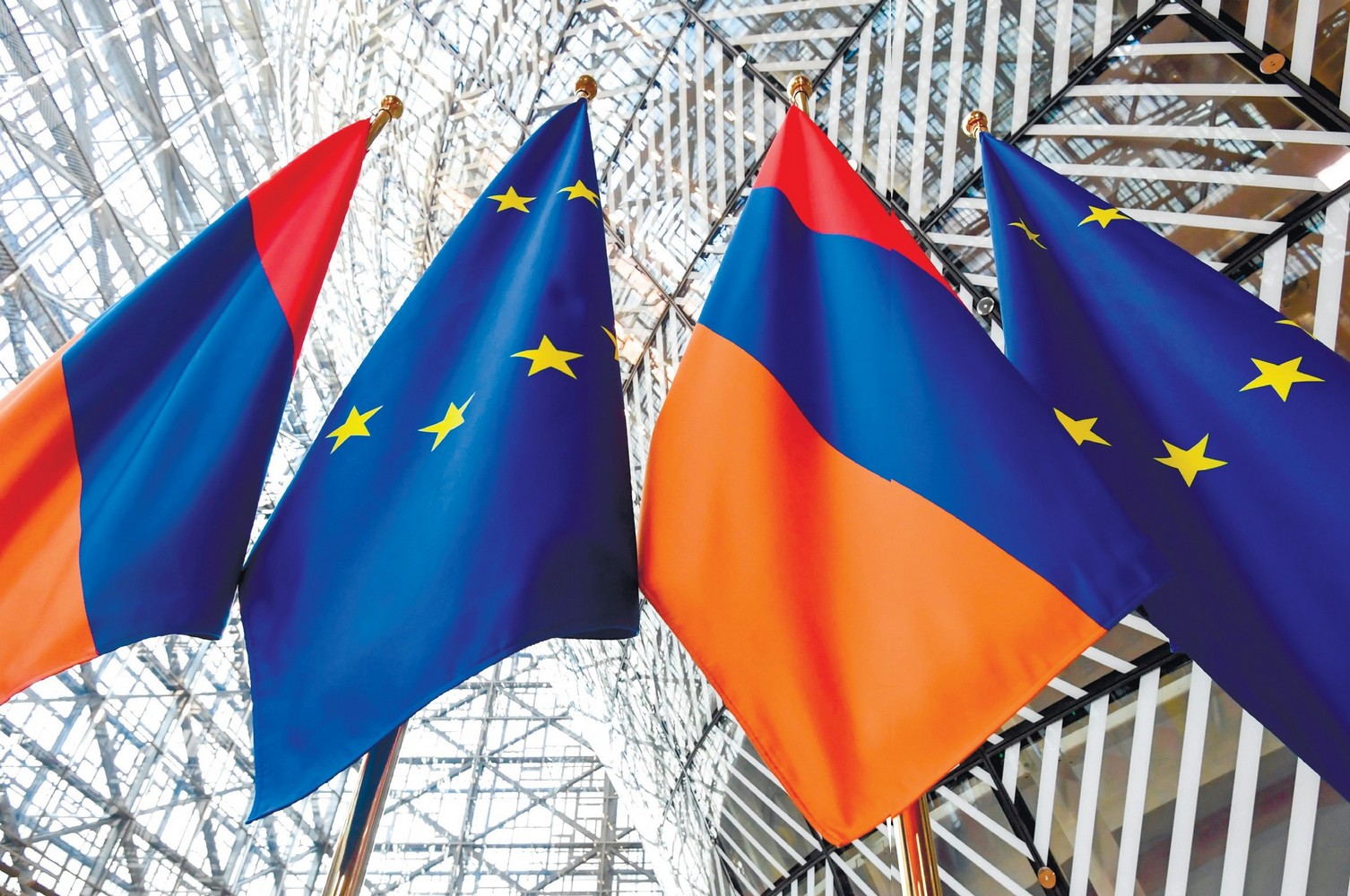
In the first days of December, European diplomatic chief Kaja Kallas announced that the European Union would allocate €15 million to Armenia to counter Russia. She noted that the funds would be directed toward "enhancing resilience" and "fighting external interference" ahead of the parliamentary elections. "We must work on combating disinformation, supporting civil society and the media to prevent pressure in this direction," Kallas said.
About two weeks later, another statement followed: "Next year, elections will be held in Armenia. Armenia has asked us for help in preventing interference from the outside." Presumably, those at 26 Marshal Baghramyan Avenue in Yerevan can breathe a sigh of relief: the European Union promises support. And not just promises, but allocates specific funds for it. The only question is: how effective will this support be?
In practice, however, the confrontation will likely manifest in the information field. And the main instruments will be grant-funded media and NGOs.
The boom in non-governmental organizations began in the 2000s. Back then, it was believed that the civil society could solve absolutely all problems. But by the beginning of the next decade, disappointment set in. It turned out that the effectiveness of NGOs was greatly exaggerated. In the US, this was discussed as early as the Biden administration, when analysing the reasons for the failure in Afghanistan. Many then cited the memoirs of Robert Gates, the former US Secretary of Defense, who noted, among other things: "In Kabul and across the country, we and our coalition partners, as well as non-governmental organisations, too often decided which development projects to undertake without consulting the Afghans. Let alone working with them or through them on what they wanted and needed."
In other words, NGOs failed in their mission. Armenia is, of course, not Afghanistan, but one should not overestimate the capabilities of grant-funded NGOs here either. In the information confrontation, things are not smooth either—Moscow has many times more opportunities to influence the situation in Armenia than Brussels does. Yes, Russian channels have been removed from the public multiplex, but people in Armenia still watch Russian television via cable networks. Unlike in Azerbaijan, a local subsidiary of Simonyan's Sputnik—Sputnik Armenia—operates here. And no one has cancelled the activity of bots on social networks. The European Union lacks such capabilities, primarily due to the language barrier. In high-level diplomacy, Yerevan may "embrace" Paris more often than Moscow, but the Russian language is still known better in Armenia than French.
Politics without white gloves
Brussels will help Armenia where it can act, figuratively speaking, in white gloves—information confrontation, exposing fakes, etc. It is by no means certain that Moscow will adhere to the same standard—acting strictly in white gloves.
The Kremlin has not yet employed economic pressure on Yerevan. Although it has enough potential to do so. Russia controls practically all infrastructure in Armenia, including the railways, which are under its concessionary management, cellular communications, gas networks, and much more. An attempt was made to nationalise the electric networks, but the Kremlin still has plenty of levers to arrange a blackout for Armenia.
Finally, there are preferences within the EAEU framework. Primarily, this means oil and gas at domestic Russian prices. Armenia is already applying to purchase energy resources from Azerbaijan, but these are at world prices. So far, this concerns one-off supplies of diesel fuel. Armenia's economy depends quite heavily on gas, where the picture is depressing. The gas system belongs to Gazprom Armenia (formerly ArmRosGazprom), and Yerevan does not decide from whom and for how much to purchase this product.
And if Russia has not yet put the relevant levers into motion, it does not mean at all that it will not deploy them tomorrow or in a week. In this case, the €15 million promised by Kallas is unlikely to change the situation. And the European Union is certainly not ready to take Armenia onto its payroll.
Use-of-force scenarios are not excluded either. Suffice it to recall media reports about the Kremlin's plans to organise a mutiny and coup in Montenegro, with Russian expats as the key acting force behind the operation. In Armenia, Moscow is unlikely to rely on relocators. There are enough official armed units here, such as Yerkrapah, VoMa, etc. There are also plenty of terrorists, including those with Middle Eastern experience.
But most importantly—Moscow has serious influence on the Armenian power institutions. There are quite a few representatives of the Garabakh Clan and Russian sympathizers in the army. Moreover, Pashinyan has very strained relations with the army top brass—both as a result of previous army purges and following the trials of officers accused of cowardice and failure to execute orders during the 44-day war. In addition to this, the joint ground forces and air defense groups with Russia have not been disbanded in Armenia. In essence, Pashinyan shares control over the Armenian army with Moscow. This already creates conditions for a military mutiny.
And it will not necessarily resemble a third-grade show, as was the case during the attempt by the former head of the General Staff of the Armenian Armed Forces, Onik Gasparyan, to displace Pashinyan. The European Union will again hardly be able to help the Prime Minister—unless they attempt to evacuate him from the country along with his family. One way or another, hopes placed on Europe have again proven to be higher than actual European assistance.
RECOMMEND:
 204
204

