

CORRIDOR AS A FACTOR
The TRIPP Project: new legal and infrastructure details

Author: Nurlana GULIYEVA
The Trump Route (Trump Route for International Peace and Prosperity, TRIPP) has become a symbol of the peace process between Azerbaijan and Armenia, and is now taking on physical and legal form. A joint statement issued on the US State Department website following a meeting in Washington between US Secretary of State Marco Rubio and Armenian Foreign Minister Ararat Mirzoyan has defined the respective shares of the parties in the project, along with other important details.
In his interview with local television channels, President of Azerbaijan Ilham Aliyev announced that construction and reconstruction work on the road infrastructure for this corridor within Azerbaijan is nearing completion.
Distribution of roles
According to the joint statement, the United States has been assigned the key role in implementing the TRIPP project. This initiative involves the establishment of a collaborative operational structure, TRIPP Development Company, in conjunction with Armenia. The company will serve as the operator for the Trump Route. The American side will receive a controlling stake, effectively securing its right to strategic and operational decisions within the project.
As stated in the official document, Yerevan is prepared to grant the company exclusive rights to develop the route for an extended period.
"Armenia is planning to award TRIPP Development Company the rights to develop the project for a period of 49 years. It is anticipated that the US will own 74%, and Armenia 26%. Following an extension of the agreement by a further 50 years, Armenia's share will increase to 49%," the statement by Marco Rubio and Ararat Mirzoyan says.
Therefore, the initial project architecture envisions American dominance, with a subsequent, phased expansion of Armenian participation.
Furthermore, the document separately records the principle of limited changeability of the ownership structure: any adjustments to the shareholder composition or ultimate beneficiaries of TRIPP Development Company are possible only after prior agreement with the governments of the United States and Armenia. This clause is of particular significance as it serves to mitigate the risks associated with non-transparent redistribution of control, thereby emphasising the interstate nature of the project.
The operator's functions are outlined in the broadest terms. The company is granted exclusive rights to plan, construct, operate and maintain all multimodal infrastructure along the designated route. These rights also extend to the establishment of special project companies and the conclusion of contracts with contractors and operators. Its area of responsibility will include railway lines, roads, bridges and tunnels, energy and digital infrastructure, and similar.
The project's financial model is based on market principles, with revenue sources including access fees for the infrastructure, commercial activity, rentals, services and other charges. TRIPP Development Company's management architecture is divided into two levels: a front office and a back office. The former will be responsible for receiving and checking documents, user information support, fee collection, and administration (tax revenues will be directed to Armenia's budget). The "back office", represented by Armenian state bodies, will retain ultimate customs decisions, security control, migration procedures, inspections, and permit issuance.
The statement also details the expected benefits for the parties. For the US, the project is seen as a tool for opening new markets for American investments, business, and goods, as well as a channel for ensuring trade connectivity, including for the supply of raw materials, critical minerals, and rare earth metals. Furthermore, it highlights the growth in trade routes between the US, Europe and Asia, which are able to function independently of the current system.
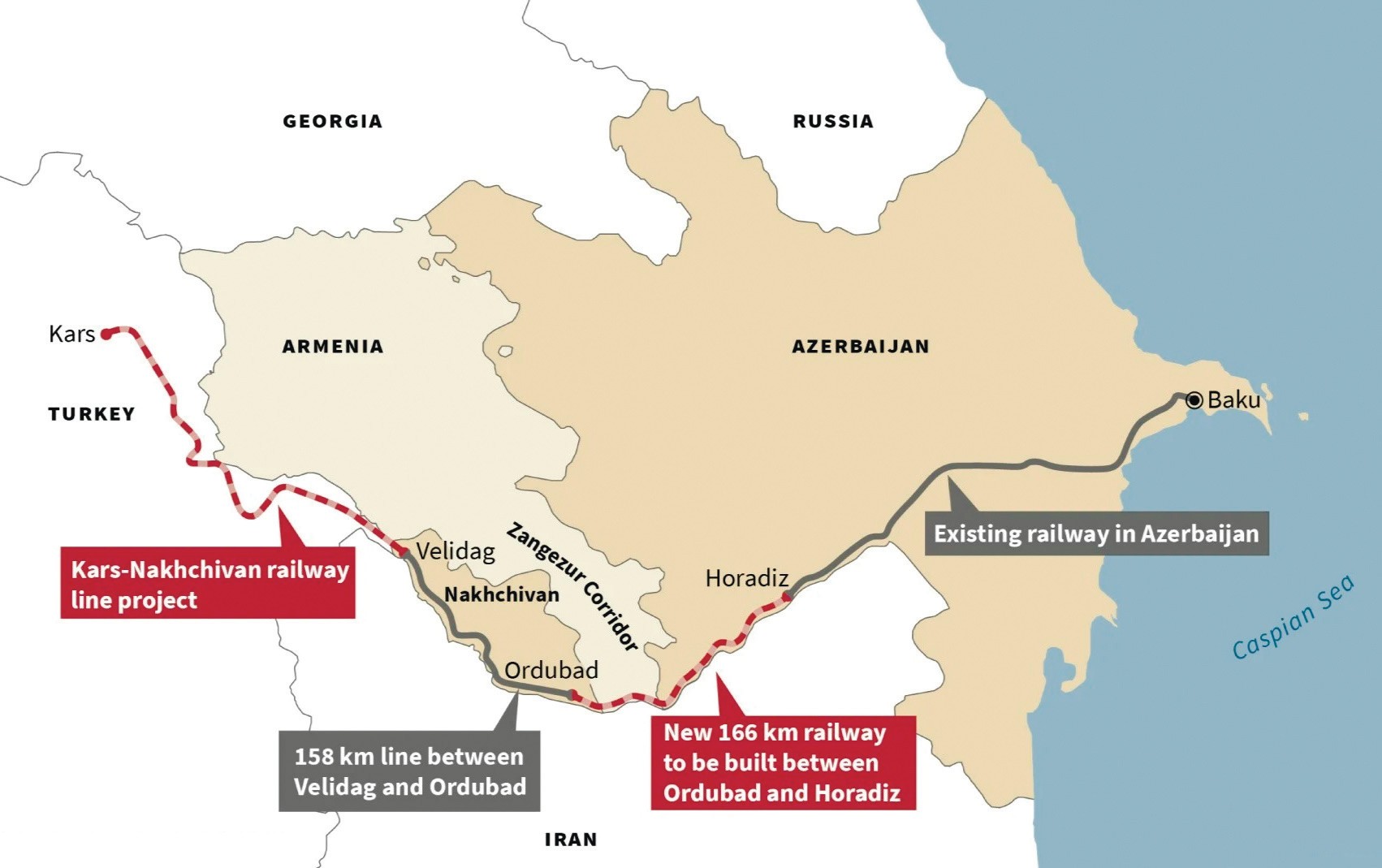
Armenia, in turn, anticipates the creation of jobs for skilled professionals, the formation of joint ventures with international companies, the development of national business capacity, technology transfer, and subsequent reinvestment in the regional economy. A key obligation for Yerevan under TRIPP becomes ensuring a simplified regime for the transit of people, vehicles, and goods between the main territory of Azerbaijan and the Nakhchivan Autonomous Republic (NAR) in both directions.
Finally, the reached agreements place several additional obligations on official Yerevan: ensuring comprehensive support for TRIPP Development Company, effective inter-agency coordination, facilitating accelerated permit acquisition and regulatory procedures, maintaining constant dialogue with American partners, and working towards normalising the regional situation. A separate clause records the necessity of developing differentiated procedures for the movement of people, vehicles, and goods, including transit between mainland Azerbaijan and the NAR.
Thus, TRIPP is taking on the tangible form of a long-term geo-economic mechanism with a clearly structured system of external control and risk distribution.
The US State Department particularly emphasised that one of the central purposes of the "Trump Route" is the restoration and guarantee of sustainable transport communication between Azerbaijan and the NAR: "By linking Azerbaijan and its Nakhchivan AR through the territory of Armenia and forming vital links along the Trans-Caspian trade route, TRIPP is expected to bring mutual benefits for both the international and the internal connectivity of the Republic of Armenia," the statement says.
Infrastructure readiness
Against the backdrop of the legal formalisation of TRIPP details between the US and Armenia, Azerbaijan is demonstrating a high degree of practical readiness for its launch. Assessments voiced by President Ilham Aliyev in an interview with local television channels show that the key elements of transport infrastructure on the Azerbaijani side are already in their final stage, while the project's further progress largely hinges on external sections of the route and the synchronisation of work with neighbouring countries.
"Our roads leading to the border with Armenia—both railway and highway—will be fully ready soon. The highway is nearly 95% complete. The railway line is complete at 70%. We can accelerate the work. But there is no particular need for this, as work on Armenian territory has not yet begun," the head of state noted.
He also indicated that the key constraining element at the current stage remains the Armenian section of the route, where about 42 km of new highway must be built. Against this backdrop, the Azerbaijani side has largely fulfilled its obligations: within Nakhchivan, the route stretches approximately 190 km, and its main part is ready for operation. Although the quality of certain sections requires modernisation, the existing infrastructure already allows for the transportation of potential cargo. However, gaps remain in both the Ordubad and Sadarak directions, the elimination of which is included in current road construction plans. Simultaneously, the construction of new railway lines, which previously did not exist, has begun. Estimates suggest these works could be completed within one to two years.
Separate emphasis was placed on the project's investment model. Azerbaijan has opened the remaining infrastructure segments to foreign capital, based on the understanding that an influx of external investment will accelerate implementation and increase the corridor's efficiency. Upon full completion, the project's capacity is estimated at up to 15 million tonnes per year, placing it in the category of major international transit routes. Strategically, the Zangezur Corridor is seen as part of not only East-West and East-South directions but also the potential expansion of the North-South route.
Traditionally, North-South implies the Russia-Azerbaijan-Iran link relying on the Rasht-Astara railway; however, the launch of the Zangezur Corridor effectively restores an alternative axis that existed even in the Soviet period. In this case, a second line of the North-South route is formed along the trajectory of Russia-Baku-Aghbend-Armenia-Nakhchivan-Julfa-Persian Gulf, which simultaneously enhances the potential of the Middle Corridor. An increase in the number of routes objectively boosts the region's overall cargo-handling capacity and reduces transit dependence on a single direction. From Nakhchivan, transport flows could be distributed along two vectors—towards Türkiye and Europe, and towards Iran, the Persian Gulf, and the Middle East. In this, Azerbaijan positions itself as a key hub for accumulating and redistributing cargo.
The Turkish factor also becomes an important element of the overall configuration. Ankara's decision to build the Kars-Nakhchivan railway provides direct connection for the autonomous republic with Türkiye's railway network, adding an extra strategic dimension to the project. The existence of a stable railway link between Nakhchivan and Türkiye is seen as a prerequisite for fully realising the corridor's potential, and synchronising construction schedules allows for cost optimisation and pre-emptive adaptation of infrastructure on both sides of the border.
The development of an alternative southern route provides additional resilience to the system. At Baku's initiative, a bridge is being built over the Araz River in the Aghbend settlement, forming a second transport arm from the region—through Iran. The project is being implemented using Azerbaijan's own funds and significantly shortens the distance between the country's mainland and Nakhchivan: the route through Iranian territory will be approximately 45-50 km instead of the current lengthy route via Bilasuvar. As a result, a dual-circuit communication model is being formed—through Armenia and through Iran—which effectively unites Nakhchivan, Eastern Zangezur, and Garabagh into a single transport and economic space.
"Naturally, Armenia will only benefit from this. Because Armenia can, and will, emerge from its current state of deadlock. Roads will open between Azerbaijan and Armenia. Roads will open between Türkiye and Armenia. Armenia will gain access to Iran's railways via Nakhchivan, and to Russia's railways via Azerbaijan. If anyone considers themselves a loser from a political point of view, that is, as they say, their problem. But if everyone looks at this issue from a pragmatic standpoint, they will be able to see the benefit for themselves," Ilham Aliyev emphasised.
Thus, Baku consistently demonstrates readiness not only to invest its own funds but also to open infrastructure segments to foreign capital, linking economic expediency with geopolitical resilience. In this context, TRIPP and the Zangezur Corridor are becoming not merely part of a peace agenda but an instrument for the long-term reconfiguration of regional logistics, where the factor of timing and the readiness of the parties is acquiring decisive importance.
The EU involvement
Alongside the active participation of the US, the potential, predominantly technical and institutional, role of the European Union in implementing TRIPP is becoming increasingly defined in expert discourse. This refers not to political mediation, but to the provision of neutral expertise and practical tools that could be deployed upon official request from the parties and with full respect for their sovereignty.
In particular, an article from the Geneva Centre for Security Policy (GCSP) points out that the EU could play a proactive, yet complementary role alongside the US in promoting sustainable peace and regional connectivity in the South Caucasus. Brussels possesses significant potential in the field of cartography and digital border mapping. Utilising tools such as the Copernicus satellite observation programme, the pan-European spatial data infrastructure INSPIRE, and modern GIS technologies, could provide transparent, objectively data-based border delimitation. Such an approach can reduce the scope for interpretative disputes and increase the level of trust between Armenia and Azerbaijan, without touching upon issues of jurisdiction and territorial integrity.
A separate direction could be research and investment support within the Global Gateway initiative. The European Investment Bank and the European Bank for Reconstruction and Development could potentially assist in preparing feasibility studies, conducting safety assessments, and optimising routes along the Nakhchivan-Armenia-Azerbaijan corridor.
Meanwhile, in European expert circles, it is emphasised that TRIPP should be considered not as an alternative but as an additional link to the already functioning Middle Corridor via Azerbaijan and Georgia, strengthening the region's overall connectivity. In this logic, the restoration of regional transport links is seen as a factor for significantly reducing trade costs and delivery times. The greatest effect, according to estimates, could be gained by Armenia, for which the resumption of overland transit would be a step towards emerging from regional isolation. This opens opportunities for restoring direct trade links with Russia and Iran, as well as facilitating access to Central Asian markets. In a broader perspective, the normalisation of Armenian-Azerbaijani relations could create conditions for discussing other regional directions, including the Armenian-Turkish track.
The digital dimension of the project is also of significant interest. Drawing on experience in implementing the European Rail Traffic Management System, the EU could—with the consent and upon request of Baku and Yerevan—assist in creating and implementing digital customs and transit platforms. This refers to systems for seamless electronic data exchange, paperless documentation, and real-time cargo tracking, which is critically important for increasing the corridor's throughput capacity.
Support for standardised customs codes, electronic seals, and intelligent logistics solutions, including radio-frequency identification technology, would allow bringing TRIPP's operational mechanisms into line with TRACECA standards and pan-European digital norms. Additionally, EU capacity-building programmes in integrated border management could enhance the skills of customs and border services, reduce delays, and promote legal and procedural harmonisation along the route—provided there is an official request from Armenia and Azerbaijan.
In parallel with this, the possibility of EU participation in financing the creation of a technical coordination platform involving Azerbaijan, Armenia, Türkiye, and Georgia—potentially co-chaired by the EU and the US—is being considered. The GCSP believes that such a structure could become a tool for harmonising regulations, synchronising technical standards, and simplifying data exchange. Drawing on its extensive experience in managing transnational corridors, the European Union is well placed to assist in the development of real-time monitoring systems, digital dashboards and cargo flow analysis tools. These tools would help to identify bottlenecks and coordinate infrastructure maintenance.
Finally, expert circles also note the EU's potential legal advisory role in developing and updating intergovernmental transit agreements in accordance with international transport conventions and European practice.
Collectively, these elements indicate that TRIPP is gradually taking shape as a systemic tool for regional transformation. Its success will depend on the synchronisation of political will, infrastructure readiness, and institutional discipline from all involved parties. In this context, Azerbaijan has already assumed the position of a key node in the new transit architecture of the South Caucasus, where economic logic is increasingly displacing the conflictual inertia of the past.
RECOMMEND:
 187
187

