

IRAN AT THE BREAKING POINT
Why social unrest is evolving into a crisis of revolutionary legitimacy
Author: Samir VELIYEV
The events currently unfolding in Iran are increasingly deviating from the standard pattern of localized socio-economic protests and are clearly exhibiting the hallmarks of a systemic crisis of legitimacy. The demonstrations that began late last year as social grievances are increasingly taking on the character of a profound political transformation within Iranian society, with the potential to reshape the country's political landscape.
Trump's warning message
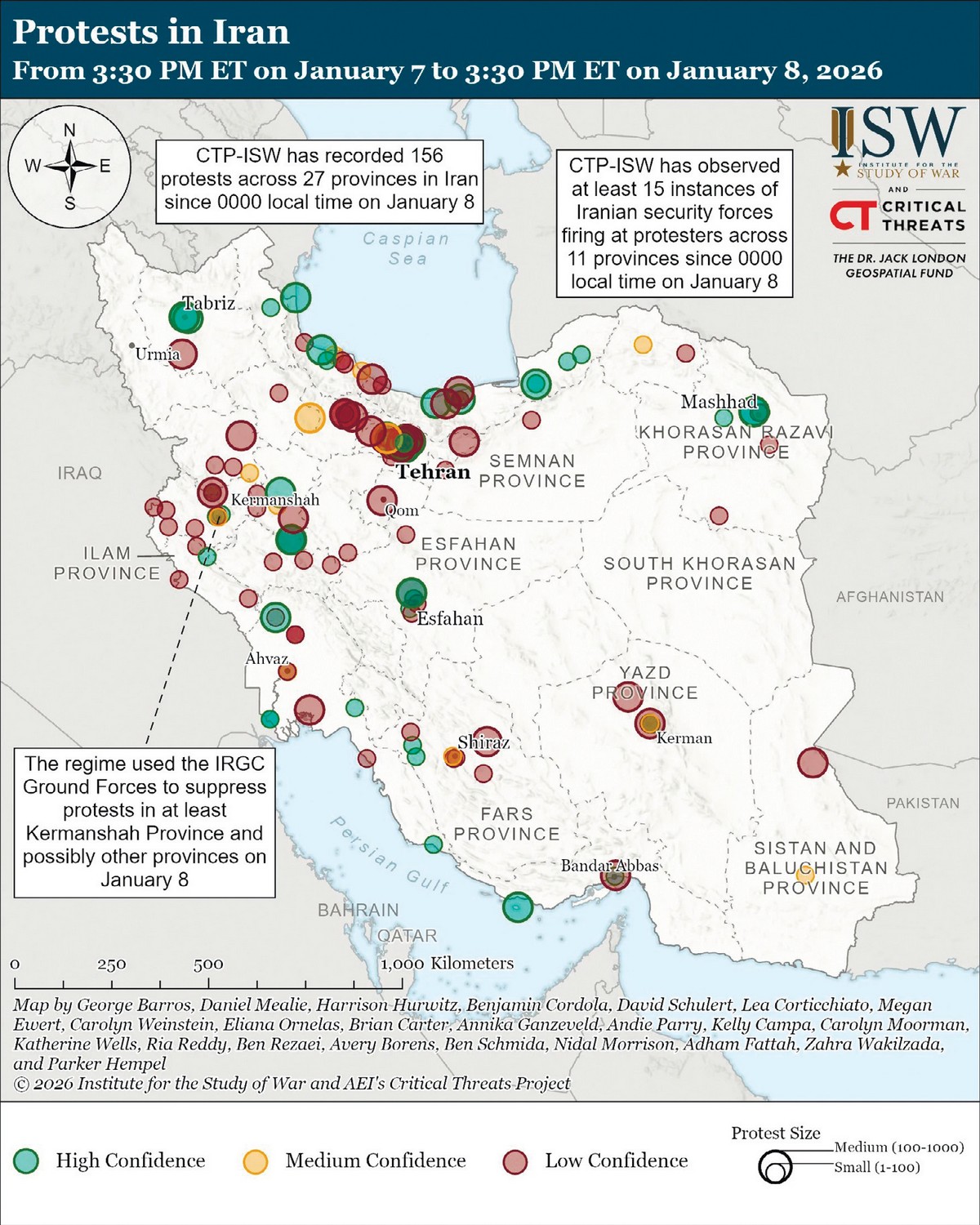
The volatile situation in Iran has escalated further, moving far beyond localised centres of discontent. While the protests were initially concentrated in the central and western provinces, within days, the wave of demonstrations swept across nearly the entire country. Significant protests have been recorded in Tehran, Mashhad, Kermanshah, and several other major cities. In response, security forces are deploying tear gas and specialized crowd-control measures against the protesters. Footage circulating on social media depicts burning police vehicles and street clashes in the capital.
Amidst the escalating unrest, the authorities have imposed near-total control over the information landscape. According to the British organization NetBlocks, Iran has entered a state of effective internet blackout; similarly, the company Cloudflare reported a 90% drop in internet traffic on 8 January. Network access appears to be restricted primarily to state institutions and the security apparatus, severely limiting the ability of citizens to receive or disseminate information.
International pressure is also mounting. In an interview with Salem News Channel, US President Donald Trump again warned the Iranian leadership about the potential fallout from a violent crackdown. He asserted that Washington would respond decisively should the authorities resort to mass violence against demonstrators. At the same time, he highlighted the courage shown by the Iranian people in the face of such pressure. Following the events in Venezuela, the world has begun to take such warnings from the American leader far more seriously.
Khamenei strikes back
The response from Iran’s Supreme Leader, Ayatollah Ali Khamenei, was swift. He claimed that the unrest, which erupted due to economic hardships, is being exploited by external forces to destabilise the nation. Khamenei explicitly linked the street protests to Trump’s statements threatening the Iranian government. He remarked that a group of vandals had destroyed public property in Tehran the previous night merely to satisfy the US President. He suggested that if the American leader were capable, he should focus on governing his own country instead.
Khamenei pointed out that over a thousand people were killed during US and Israeli strikes on Iran in June 2025 and emphasised that Trump himself had acknowledged his role in those events. He noted the contradiction in Trump claiming to have issued orders during a conflict while subsequently professing to be a supporter of the Iranian people. He lamented that a handful of reckless and inexperienced individuals believe these claims and act according to his will.
The Supreme Leader further asserted that the Islamic Republic would not tolerate "agents backed by foreign powers". He argued that Iranian society rejects serving as mercenaries for external powers, noting that history shows arrogant and tyrannical forces—from the Pharaohs to Reza Shah—have always fallen at the peak of their self-assurance. He declared that the Islamic Republic was established through the blood of hundreds of thousands of noble people and would not retreat before saboteurs.
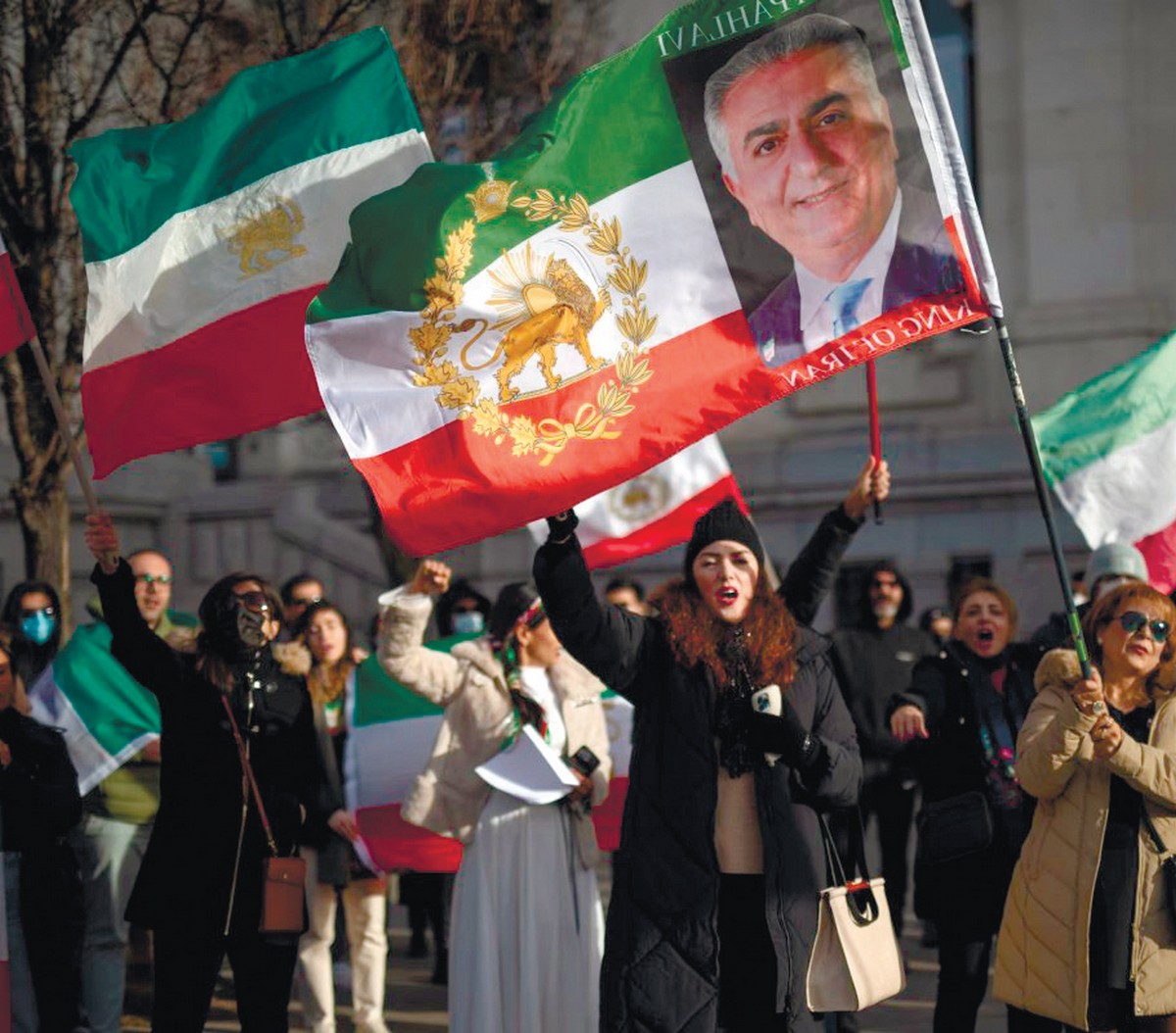
The tone of Khamenei’s speech suggests that the authorities are deeply concerned that social grievances will morph into a political movement driven by foreign interests, particularly those of the US and Israel. By criticizing the era of the Shah’s rule, the Supreme Leader was likely making a pointed reference to Crown Prince Reza Pahlavi, who has recently become more active in trying to position himself as an alternative source of legitimacy.
Some Western media outlets have begun portraying Reza Pahlavi as a "leader of the protests," citing instances of demonstrators chanting monarchist slogans and his family name. However, such a narrative is more of a media construct than a political reality. The Prince has lived in the West for decades and maintains only sporadic contact with the political landscape inside Iran, limited to a narrow circle of opposition figures who lack significant influence. While Reza Pahlavi may enjoy support from certain Western political circles, especially in the US, this is insufficient to transform him into a genuine focal point for the Iranian protests. Grassroots mobilization in Iran is primarily driven by socio-economic pressure and domestic frustration, rather than an exiled leader, regardless of how well that narrative fits Western political discourse.
Renegotiating the "social contract"
The ideology of the Islamic Revolution was founded not only on political Shiism but also on the concept of social justice. Khomeini’s revolutionary project was framed not just as a religious alternative to the Shah, but as a social upheaval against inequality, corruption, and foreign dependency. At its core was the concept of the mostazafin—literally, the oppressed—in whose interests the Islamic state was supposed to exist. The Shah was overthrown not merely for his authoritarianism, but because his regime was seen as an elite establishment integrated into Western economics and detached from the needs of the masses.
During its early decades, the Islamic Republic institutionalized this mission through a vast system of redistribution supporting the lower and middle classes. Subsidies for food, fuel, and electricity, alongside affordable housing, free education, and healthcare, created a unique social contract between the state and the people. Political restrictions and a rigid ideological framework were balanced by the belief that the state stood, both materially and morally, with the common citizen.
By the turn of the 21st century, however, this contract began to suffer from systemic decay. The nation's economic structure became increasingly dominated by closed clans linked to the Revolutionary Guard (IRGC), the clergy, and semi-state foundations. Institutions originally intended as mechanisms for social justice evolved into channels for accumulating capital and political leverage. Amidst sanctions, inflation, and chronic inefficiency, the subsidy model began to erode while social inequality widened.
Public perception has shifted toward a new elite whose lifestyle and detachment from society mirror the very "Pahlavi elite" the revolution sought to replace. Consequently, a large segment of Iranian society views current events not as a crisis of the Islamic system itself, but as a betrayal of its foundational principles. This is why protest rhetoric increasingly focuses not on rejecting the Islamic Republic, but on accusing it of ceasing to be Islamic in a social and moral sense. This logic makes the current protests particularly perilous for the leadership: they do not just challenge the system's control, but its very revolutionary legitimacy. When the state is no longer seen as the protector of the oppressed, it loses the symbolic capital that allowed it to remain resilient for decades despite external pressure.
Fears of the regime
Contrary to common Western media narratives, a significant portion of the protest movement is not seeking a return to the monarchy or the total dismantling of the Islamic system. For many protesters, the 1979 Revolution remains the source of legitimacy, albeit in its original form rather than the version currently upheld by the state. In their eyes, the current political and economic order is not a continuation of the revolution but a distortion of it: instead of justice and independence, they see corruption and a closed elite system.
Consequently, many slogans appeal not to Western models but to the ideals proclaimed during the fall of the Shah. For large segments of the population—particularly in the provinces and among vulnerable groups—the issue is not the Republic itself, but that it has ceased to be Islamic or Republican in the true sense. They are demanding greater freedom on one hand, and a return to the fair distribution of wealth on the other, believing it has been usurped by the ruling bureaucracy.
In this context, attempts to cast Reza Pahlavi and the exiled opposition as protest leaders appear more like a media fabrication. Monarchist slogans exist but do not drive the movement’s dynamics; its real engine is social disillusionment and a sense of betrayal regarding the revolutionary contract. This makes the situation exceptionally dangerous for the authorities. A protest that demands the "return" of the revolution, rather than its abandonment, undermines the regime's legitimacy from within and cannot be dismissed simply as an external conspiracy.
Nevertheless, it cannot be ruled out that with significant external support, Reza Pahlavi could strengthen his position and eventually become a player in a future political transformation. The US and Israel are objectively interested in both the radicalisation of the crisis and its personification through a political figurehead. Meanwhile, various sources report that at least 600 people, including minors, have been killed since the protests began, indicating a rising scale of violence. Under these circumstances, social discontent is clearly evolving into a systemic domestic crisis where economic, social, and external factors converge to threaten the stability of the regime.
RECOMMEND:
 234
234

