

A BOARD FOR PEACE
Azerbaijan in a new model of international conflict resolution under US auspices
Author: Ilgar VELIZADE
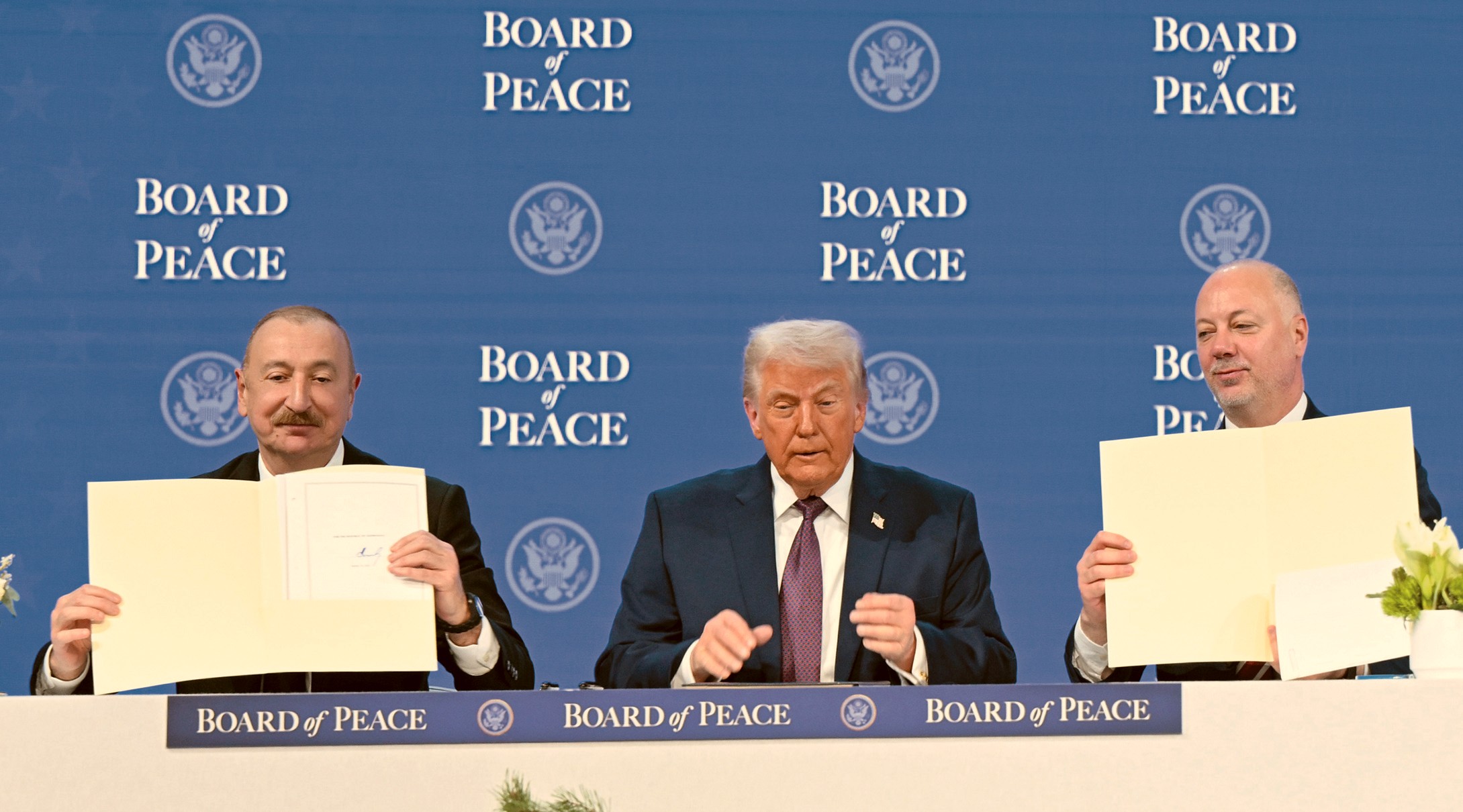
One of the most significant recent developments has been the signing of the Charter of the Board of Peace (BoP) in Davos on January 23, which, as many politicians and observers believe, symbolises the beginning of a new phase in the system of global political relations. The old world no longer exists, while the new one is only just emerging. Critics of the initiative, however, portrayed the situation as if the American leader intended to replace the United Nations with the newly created Council.
In his response to these claims, the US President Donald Trump, speaking at the ceremony marking the signing of the founding documents, stressed that the BoP would not seek to replace the UN in addressing global challenges. Moreover, he stated that the new organisation would cooperate with the UN. He also outlined key foreign policy issues in the Middle East and worldwide that the initiative would address. One of its primary priorities will be resolving the conflict in the Gaza Strip.
The Board of Peace as a parallel to the UN?
Trump made it clear that the establishment and formalisation of the BoP do not represent an attempt to replace the UN—either formally or substantively. Although the media frequently portrays the new structure as an alternative to the UN, such an interpretation is not supported by the founding documents, the declared functions, or the overall logic behind the BoP’s structure. It is not a competing universal institution but rather a fundamentally different format of interaction. At the same time, the head of the White House, in his characteristic manner, expressed his views clearly and unequivocally, criticising existing approaches to resolving conflict situations. "The UN simply has not been particularly effective," he said. "I am a great admirer of the UN’s potential, but it has never realised that potential. The UN was supposed to end many of the wars that I brought to an end. I did not turn to them. I did not even consider turning to them."
Indeed, the BoP was conceived as a voluntary platform for political dialogue and consultations among states. It does not provide for universal membership, is not endowed with supranational authority, and does not possess legally binding decision-making mechanisms. Unlike the UN, which is embedded in the system of international law and holds a formal mandate in maintaining peace and security, the BoP is not authorised to impose sanctions, deploy peacekeeping missions, or shape norms of international law. Its decisions are advisory and political-declarative in nature and do not create binding obligations for participants.
At the same time, it would be incorrect to view the BoP as yet another formal superstructure within an already overloaded system of international institutions. The project associated with Donald Trump is not limited to declarative criticism of the existing model of global governance, which his supporters consider excessively bureaucratic, slow-moving, and politically constrained. It represents an attempt to construct a different format—less cumbersome and not overloaded with functions, yet capable of exerting genuine political influence. Within this logic, the BoP is conceived not as a symbolic forum for statements, but as an instrument focused on practical results, direct agreements, and a limited yet effective set of tools for influencing the development of specific conflict situations.
From Gaza to global objectives
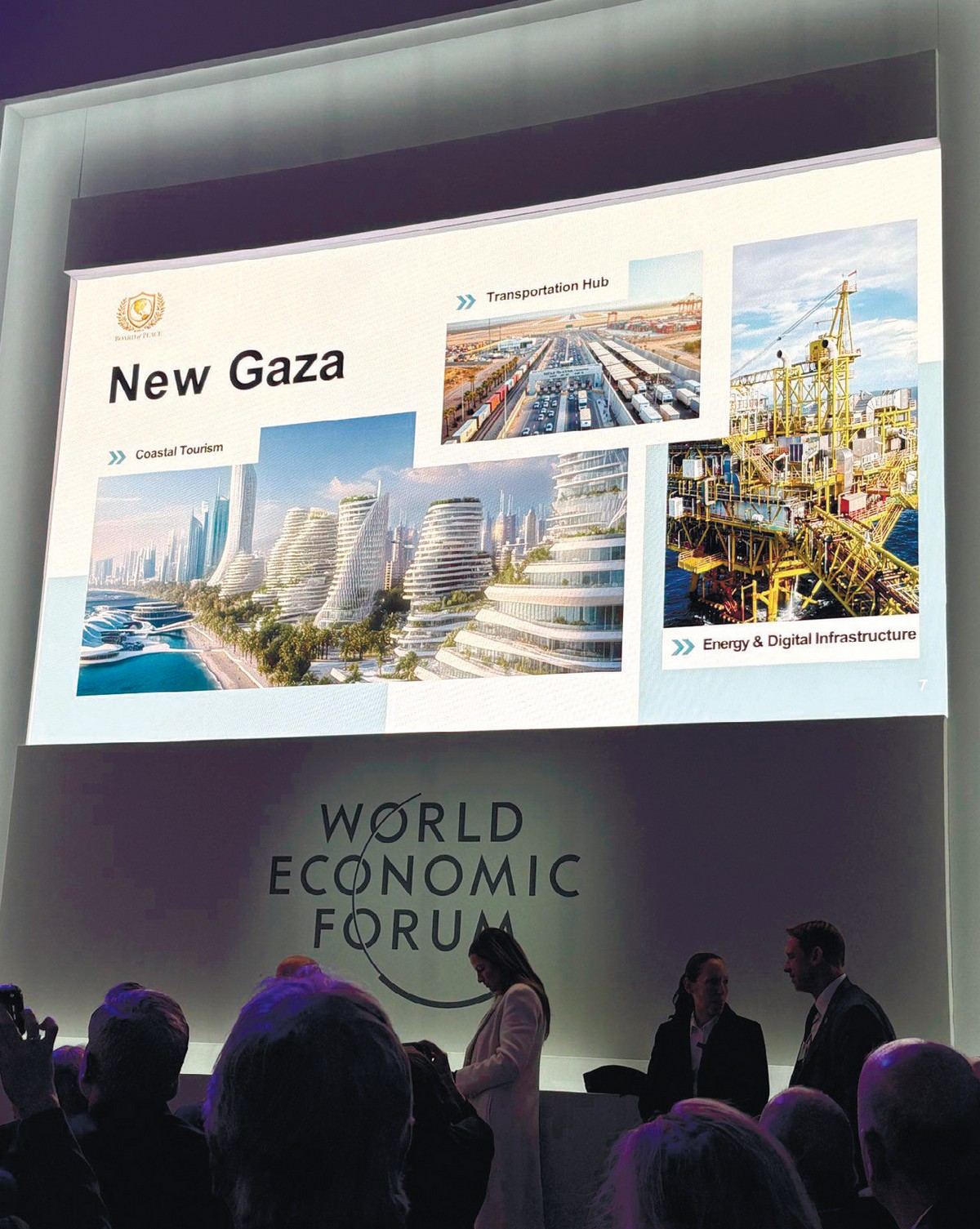
In this context, it is important to consider the origins of the initiative itself. It directly stems from the "Comprehensive Plan for Ending the Conflict in Gaza", presented by Trump to world leaders in October 2025. The plan includes 20 points and provides for ending the war between Israel and Hamas, the demilitarisation of the Gaza Strip, and the subsequent reconstruction of the enclave. In November 2025, it received approval from the UN Security Council in the form of a resolution, thereby creating a political and legal foundation for establishing a separate mechanism to implement the agreements.
It should be recalled that the BoP was initially conceived precisely as a tool to support this plan—a structure that would coordinate Gaza’s reconstruction and maintain long-term stabilisation of the situation. However, during the process of institutionalisation, its mandate was expanded. In several official documents and working versions of the charter, the BoP is already described as a mechanism that could potentially be applied to other conflicts as well. This reflects a broader objective—not merely participation in a single specific peace process, but the creation of a US-managed platform for resolving international crises outside traditional multilateral institutions.
In January, the project moved from the conceptual stage to practical implementation. The Trump administration officially announced the establishment of the BoP, sent invitations to heads of state proposing that they join the structure and sign the participation charter. The signing ceremony itself, attended by leaders of nearly two dozen countries, demonstrated considerable practical interest in the initiative and suggested that it has strong prospects. Among the first to sign the Charter of the BoP in Davos were the leaders of Azerbaijan, Ilham Aliyev, and Armenia, Nikol Pashinyan, the heads of most Middle Eastern states, as well as the presidents of Kazakhstan and Uzbekistan. Notably, the presidents of Russia and Belarus also endorsed the idea of joining, although they did not attend the signing ceremony.
At the same time, the White House invited European leaders, as well as Ukraine and the Prime Minister of Canada, to participate in the initiative. However, most EU countries preferred to keep their distance from the BoP. This is linked to concerns among European elites about losing influence and finding themselves outside the circle of states that make key decisions and shape the rules of global politics.
At the same time, this does not signify a rupture in transatlantic relations. The EU and the US remain closely interconnected through issues of security, economic cooperation, and coordination of policies concerning Ukraine and the Middle East. Nevertheless, the current situation indicates that Europe is attempting to restrain initiatives from the White House and, where necessary, oppose them in order to preserve its status as one of the principal actors on the global stage and avoid becoming merely an executor of decisions made by others.
Post-conflict agenda as an important element of the new world order
As for the current signatories, for many states participation in such an initiative represents a means of establishing a direct political channel to the US administration, enhancing their international agency, and consolidating their role within the emerging new system of international relations. For Azerbaijan and Armenia in particular, this carried special regional and strategic significance, underscored by the Washington agreements of 2025. In August of last year, under the auspices of the US administration, a political package of agreements between Baku and Yerevan was signed, marking an important turning point after decades of conflict between them and numerous attempts at peaceful settlement. This declaration and the accompanying agreements were presented as a step towards establishing stable interstate relations, renouncing military confrontation, and opening new opportunities for regional integration and infrastructure connectivity.
Within this context, the participation of Azerbaijan and Armenia in signing the Charter of the BoP in Davos reflects the desire of both countries to consolidate the international political dividends gained during the Washington process and to demonstrate their active role on the global stage. For Azerbaijan, this represents an opportunity to demonstrate and further consolidate, within the framework of international law, the results of its victory over Armenia and to reaffirm the international legitimacy of the peace agenda. In this regard, it is important to note that on the sidelines of the summit, the US leader met with only two presidents: those of Azerbaijan and Ukraine. This once again highlights the American leader’s attention to Baku and underscores Azerbaijan’s place within the BoP.
For Armenia, participation in the BoP pursues the goal of consolidating the peace agenda within international formats, thereby narrowing the room for manoeuvre of opposition forces with revanchist tendencies, which are oriented towards returning to a confrontational logic and revising the agreements reached. Integrating Armenia into new international initiatives involving the US enables the current authorities to present any potential departure from the peace course, including through a scenario of leadership change, as a step fraught with international isolation and the loss of foreign policy support. At the same time, this facilitates the diversification of foreign partnerships and reduces dependence on traditional centres of power amid the transformation of the security architecture in the South Caucasus.
An important symbolic element of this process was a letter sent by Donald Trump to the leaders of Azerbaijan and Armenia, in which the American president expressed gratitude for their participation in drafting and signing the Charter of the BoP. The message emphasised the role of Baku and Yerevan as states that demonstrated political will to move beyond a protracted conflict and readiness to integrate into a new architecture of international responsibility and security. Thus, the participation of both countries was presented not as a formal gesture but as a contribution to the formation of a new model for resolving regional crises with active US mediation.
Scenarios for future development
Speaking about the future of the BoP, its viability will primarily depend on the position of the US and on how willing the participants themselves are to engage genuinely in resolving complex international problems rather than limiting themselves to formal declarations. In the longer term, two main development scenarios are possible.
In the first scenario, the BoP could become established as a permanent yet functionally limited format. Essentially, it would become a kind of club of countries seeking to address security and conflict issues outside traditional international organisations. Such a mechanism would not replace existing institutions but would rather complement them by taking on tasks that, for various reasons, those institutions are unable to fulfil.
In the second scenario, the BoP could remain a temporary project characteristic of the current phase of global transformation. In this case, it would reflect the crisis of the old international security system and serve as an attempt to temporarily fill the emerging governance vacuum until more stable and comprehensible forms of global governance emerge.
At the same time, regardless of which path development takes, such formats are likely to remain in demand, as contemporary international politics increasingly prioritises pragmatic agreements and situational diplomacy over universal rules and procedures.
RECOMMEND:
 173
173

