

EXPORT RESOURCE
Baku making green power generation a key part of the regional energy landscape
Author: Aghasaf NAJAFOV
As part of the global energy transition towards 2030, Azerbaijan is consistently developing the renewable energy sector, attracting foreign investors. The ultimate goal of these steps is to create energy corridors and export green electricity to Türkiye and the European Union. The availability of RES resources will assist in the reduction of natural gas consumption at thermal power stations, with the fuel saved being directed towards external markets. In addition, there are plans to use green energy to develop energy-intensive sectors within the IT industry, such as data centres. These priorities were discussed during the fourth ministerial meeting, held under the auspices of the Advisory Council on Green Energy and with the participation of the country's President, Ilham Aliyev.
Action Plan
In recent years, Azerbaijan has successfully attracted significant foreign investment for large-scale renewable energy generation projects and is also participating in international initiatives to create infrastructure for electricity exports.
According to industry experts, the total economic potential of renewable energy in the country that is available for development has been estimated at 27 GW.
Azerbaijan has designated the Garabagh and East Zangezur economic regions, as well as the Nakhchivan Autonomous Republic, as green energy zones. For the first two regions, experts from the Ministry of Energy, with the support of the Japanese energy company TEPSCO, have prepared a comprehensive concept and action plan, which are already being implemented.
It is noteworthy that we have established partnerships with companies from the Persian Gulf, China, Türkiye and Europe that are investing in the development of renewable energy. Solar and wind power stations are being constructed with financial and technical support from ACWA Power and Masdar of Saudi Arabia and the UAE, as well as through investments from bp, Nobel Energy and major Chinese companies.
Over the past five years, the Garabagh region has seen the commissioning of small run-of-river and dam-mounted hydroelectric power stations, with a total capacity of 307 MW.
"In January of this year, we inaugurated the largest wind farm in the region to date, with a capacity of 240 MW. This facility was constructed and financed by ACWA Power. This is in addition to the volume of green energy that we have been generating since 2023, following the construction by Masdar of a 230 MW solar power plant," said President Ilham Aliyev, speaking at a meeting of the Advisory Council. Several projects are already underway, and we expect new renewable energy power stations to come on stream in the coming years. By 2032, we anticipate generating between 6 and 8 GW of electricity from renewable sources.
It is expected that by 2027, investment in the construction of 10 solar and wind power stations will exceed $2.7 billion, and the country’s power system will be expanded by an additional 2 GW of capacity.
These developments are progressing rapidly, and Javid Abdullayev, Director of the State Agency for Renewable Energy Sources, who was speaking at the forum, noted that by 2030, projects in the solar, wind and hydro sectors with a total capacity of up to 6 GW will be implemented, and up to 8 GW by 2033. In this regard, it is forecast that the share of renewable energy in the country’s total electricity generation will reach 25% in 2027 and exceed 30% in 2030.
For environment and economy
A dedicated plenary session was convened to address the development of green energy and its implementation across various sectors. Parviz Shahbazov, Head of the Ministry of Energy of the Republic of Azerbaijan and a forum participant, noted that the world is rapidly entering an era of renewable electricity, driven by artificial intelligence (AI), data centres and digitalisation.
Speaking at the forum, the President of Azerbaijan emphasised that, in addition to the export of green electricity, a priority task is its use for domestic needs, with the aim of replacing the natural gas used to generate electricity at thermal power stations.
"It is imperative that we establish the foundations for economic growth and industrial advancement, encompassing our strategic initiatives for the telecommunications sector, artificial intelligence, and data centres. These endeavours are currently in their initial phases of development. Especially after the signing of the Charter on Strategic Partnership between the United States of America and Azerbaijan last month in Baku by myself and the US Vice-President," Ilham Aliyev emphasised the wide-ranging nature of the agreement, which covers areas including artificial intelligence, energy and telecommunications.
One of the government's key objectives is to position the country as a global leader in the field of AI. In addition, it is essential that we develop the infrastructure for data centres, which are highly energy-intensive. In this regard, additional sources of renewable energy are crucial for ensuring a sustainable and cost-effective power supply for digital infrastructure.
The development of the renewable energy sector will also free up gas for domestic consumption, thereby increasing exports of the country's natural gas. "I understand that Azerbaijan recognises green electrification as a means of catalysing the reduction of domestic consumption of fossil fuels, which creates additional opportunities for revenue from gas exports. This region has enormous potential for electrification, particularly in the heating of homes and industrial facilities,” remarked Dan Jørgensen, European Commissioner for Energy and Housing, who is participating in the Advisory Council. He added that he welcomed the plans to establish cross-border electricity interconnectors, which have been announced in recent years.
President Aliyev also believes that the priority today is the construction of power lines to ensure the supply of ‘green’ electricity to external markets. “We need to work together on the construction of power lines—on laying a power cable from Azerbaijan to Europe along the Black Sea seabed and another from Central Asia to Azerbaijan. Agreements on both projects have already been signed, and the feasibility study is almost complete for one project and will be finalised for the other. In the long term, once all these projects have been implemented, we will see that they will become very sustainable and, I would say, vital for the energy corridor of many countries,” noted Ilham Aliyev.
Energy bridge
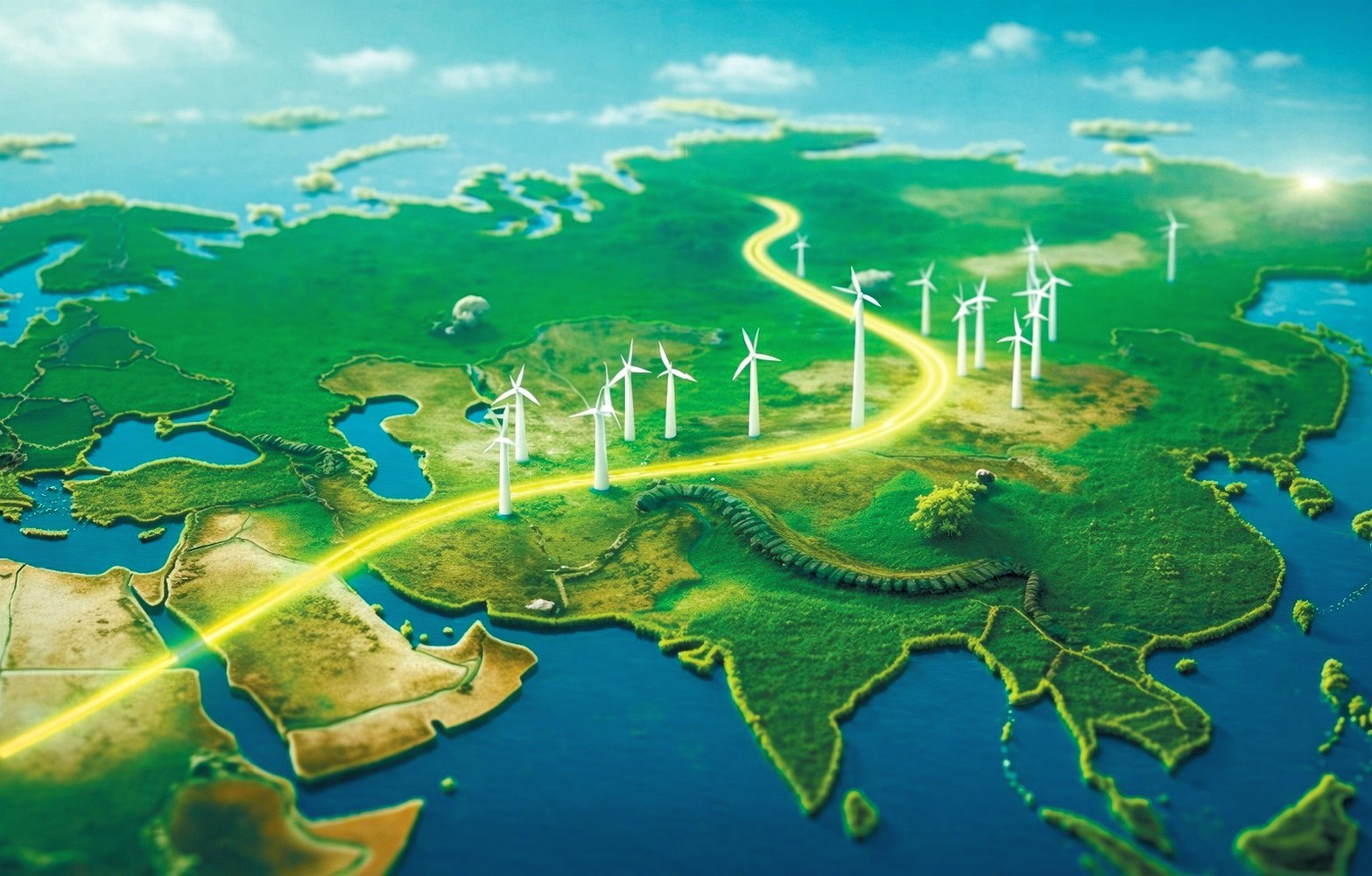
Azerbaijan is proactively engaged in the establishment of 'energy bridges' with the objective of exporting green electricity, primarily to Türkiye and Europe. The project is scheduled to be organised through four power interconnectors, which are at various stages of implementation. Political agreements have been reached at the highest level regarding one of them (Azerbaijan-Georgia-Türkiye-Bulgaria). In addition, an interconnector is being implemented that will enable the export of green energy via the Nakhchivan Autonomous Republic to Türkiye and on to Europe.
The primary initiative in this area is the project between Azerbaijan, Georgia, Romania and Hungary, involving the laying of an electrical cable along the seabed of the Black Sea (Black Sea Energy). The commencement of work on this project is scheduled for 2029. Please be advised that the Italian company CESI SpA has been selected as a consulting partner for the preparation of the feasibility study. The establishment of a joint venture to implement the second interconnector across the Caspian Sea, with headquarters in Baku, is also nearing completion.
"By assessing the technical and economic viability of electricity trade across the Caspian Sea, this initiative has the potential to unlock large-scale renewable energy resources, strengthen energy security and sustainability, and create new pathways for the exchange of clean energy," said Sunnia Durrani-Jamal, Head of the Asian Development Bank (ADB) Office in Azerbaijan, at a seminar on the feasibility study for the 'Caspian Green Energy Corridor' project. This is a promising response to the current challenges of the energy transition, demonstrating how national ambitions in the field of renewable energy can be transformed into coordinated regional solutions.
According to her, the ADB remains committed to supporting Azerbaijan's transition to green energy through an integrated and regionally connected approach. In addition to financing, the ADB plans to provide the public and private sectors with technical expertise to structure complex projects.
The European Union also intends to support Black Sea Energy, as noted by Cristina Lobillo Borrello, Director of the Energy Platform and International Relations Task Force at the European Commission's Directorate-General for Energy, during the Advisory Council meeting: The project will be a significant step in strengthening connectivity between Europe and the South Caucasus. The European Commission has recently included it in the list of projects of mutual interest, a status which will enable it to apply for funding under the Connecting Europe Facility programme.
Relevant authorities in Kazakhstan and Uzbekistan have also expressed interest in the Trans-Caspian electricity transit through Azerbaijan. This was discussed at a seminar dedicated to the development of the feasibility study for the 'Central Asia-Azerbaijan Green Energy Corridor'.
Sanjar Zharkeshov, Kazakhstan's Deputy Minister of Energy, has announced that the country aims to increase its total energy generation capacity to 26 GW by 2030, with 30–35% of this to be derived from renewable energy sources. The plan is to export this green energy to European markets via this corridor.
Feruz Kurbonov, Chairman of the Board of Uzbekistan's National Grid, shares this view, stating that his country is investing heavily in key energy infrastructure and the renewable energy sector. Uzbekistan aims to increase the share of green energy to 20 GW by 2030—40% of the total capacity of the national power system—and to establish exports to Europe by connecting to the Uzbekistan-Kazakhstan-Azerbaijan regional transit network.
As we can see, Azerbaijan has once again confirmed that the development of renewable energy in the country is gradually evolving from a separate energy sector into one of the key elements of its long-term economic strategy. As new capacity comes online and export interconnectors are established, green energy generation will simultaneously strengthen energy security, expand export potential and lay the foundations for the development of new high-tech industries.
RECOMMEND:
 134
134