

YEREVAN BEFORE THE BATTLE
Armenian opposition seeks new leader and prepares for parliamentary elections

Author: NURANI
In the post-Soviet space, political passions typically reach boiling point ahead of presidential elections, while parliamentary ones are often sidelined. Armenia, however, is one of the few exceptions. While the country does maintain the office of the presidency, the primary powers are vested in the Prime Minister, who is elected by parliament.
Today, few remember how back in 2013, Georgian President Mikhail Saakashvili planned a political manoeuvre. Having served two presidential terms, he intended to transform Georgia into a parliamentary republic, transfer key powers to the head of government, and transition into the premiership. However, he lost the decisive elections that year to Georgian Dream.
A similar scheme was attempted in 2018 by the then-President of Armenia, Serzh Sargsyan. At that time, the post of Prime Minister was held by Karen Karapetyan, a former top manager at Gazprom. By all indications, he was meant to remain in office—Moscow was clearly grooming him for the role of a local "Ivanishvili". At the last moment, however, Sargsyan decided to head the government himself. The ensuing events are well-documented: Nikol Pashinyan’s (then an opposition MP) trek through Armenia’s regions, the "barbecue revolution," and the forced resignations of both Sargsyan and Karapetyan, after which Pashinyan assumed the premiership. He subsequently held new elections, resulting in a parliamentary majority for his "Civil Contract" supporters.
Now, eight years after his revolution’s victory, Nikol Pashinyan faces another electoral trial. This time, however, the balance of power has shifted.
Prime minister's changing image
On the eve of the elections, the incumbent Prime Minister finds himself in a rather ambiguous position. On one hand, he clearly intends to publicly distance himself from his former image. The camouflage t-shirt and backpack have been replaced by a respectable coat and hat. Yet, Nikol Pashinyan still intends to play on populism and exploit his "man of the people" persona. Photos periodically circulate through the media and social networks showing Pashinyan, in his hat and coat, meeting the public and subsequently eating pierogies or churchkhela on a bus. Such approachability evokes delight in some, while drawing sharp criticism from others. This is particularly notable given that Pashinyan is displaying this "pastry democracy" amidst a glaring silence regarding the Iranian crisis, despite the vital importance of relations with Iran for Armenia.
Another contentious pre-election detail is his separation from Anna Hakobyan, his common-law partner, whom the Prime Minister never officially married despite having four children. One can only speculate about the reasons for this move, though many are convinced that Ms Hakobyan was becoming too prominent in the spotlight. Furthermore, her relocation from the government residential complex to a standard rented flat is intended to demonstrate Pashinyan’s lack of "corrupt funds". This comes despite the fact that the incumbent Prime Minister’s associates in "Civil Contract" frequently find themselves embroiled in corruption scandals.
Until recently, Nikol Pashinyan demonstrated remarkable political survival skills. He managed to remain in power and win elections following Armenia's defeat in the 44-day war, a feat that surprised many experts. To be fair, however, Pashinyan—now a peacemaker—conducted that campaign under revanchist slogans, even promising the re-occupation of the cities of Shusha and Hadrut.
Today, the Prime Minister’s political record includes another lost war. In the autumn of 2023, Azerbaijan conducted local anti-terrorist raids in Garabagh and restored its sovereignty over all territories within its internationally recognised borders. No opportunities or prospects for revenge remain; moreover, Armenia has significantly depleted the "hardware" of its armed forces. In such a situation, Pashinyan has no choice but to project a peaceful stance, which is exactly what he is doing ahead of the elections. This is especially true since, following negotiations in Washington in August 2025, Pashinyan has no room for manoeuvre on the Garabagh front. Nevertheless, this does not mean his political opponents will not actively exploit revanchist slogans.
The opposition front
Pashinyan has been saved in the turbulent waters of politics by the fragmentation of the opposition and its lack of a strong, charismatic leader. For a long time, the anti-Pashinyan front was led by figures from the "Garabagh clan"—Robert Kocharyan and Serzh Sargsyan. Kocharyan proved to be a particularly dangerous opponent for Pashinyan—an experienced political player and a master of intrigue who is not known for being overly scrupulous in his methods of political struggle.
It must be noted that the Armenian opposition remains fragmented today, consisting of several centres. The Dashnaktsutyun party, which opposes Pashinyan, is clearly not a frontrunner in the polls, but the Dashnaks possess substantial financial resources thanks to the overseas diaspora. They wield significant informational leverage, particularly within the Armenian-language segment. Dashnaktsutyun, where new members still take an oath on the graves of "heroes" while touching the party flag and a pistol, has used terror as a method of struggle since the end of the 19th century. The Dashnaks stand a good chance of securing support from the Church, where the situation is also complex.
On one hand, following a series of rallies led by Archbishop Bagrat Srbazan that quickly descended into a caricature, many began to speak of the Armenian Church’s political potential with derision and open mockery. However, now that Pashinyan has declared war on the Church as an institution—including the Catholicos of Etchmiadzin, Garegin II—the situation has changed fundamentally. The "cavalry charge on Etchmiadzin" has clearly stalled; Pashinyan has failed to achieve any tangible results beyond alternative liturgies. Consequently, the primary objective—to bring the Church under control during the peak of the election campaign—remains unfulfilled.
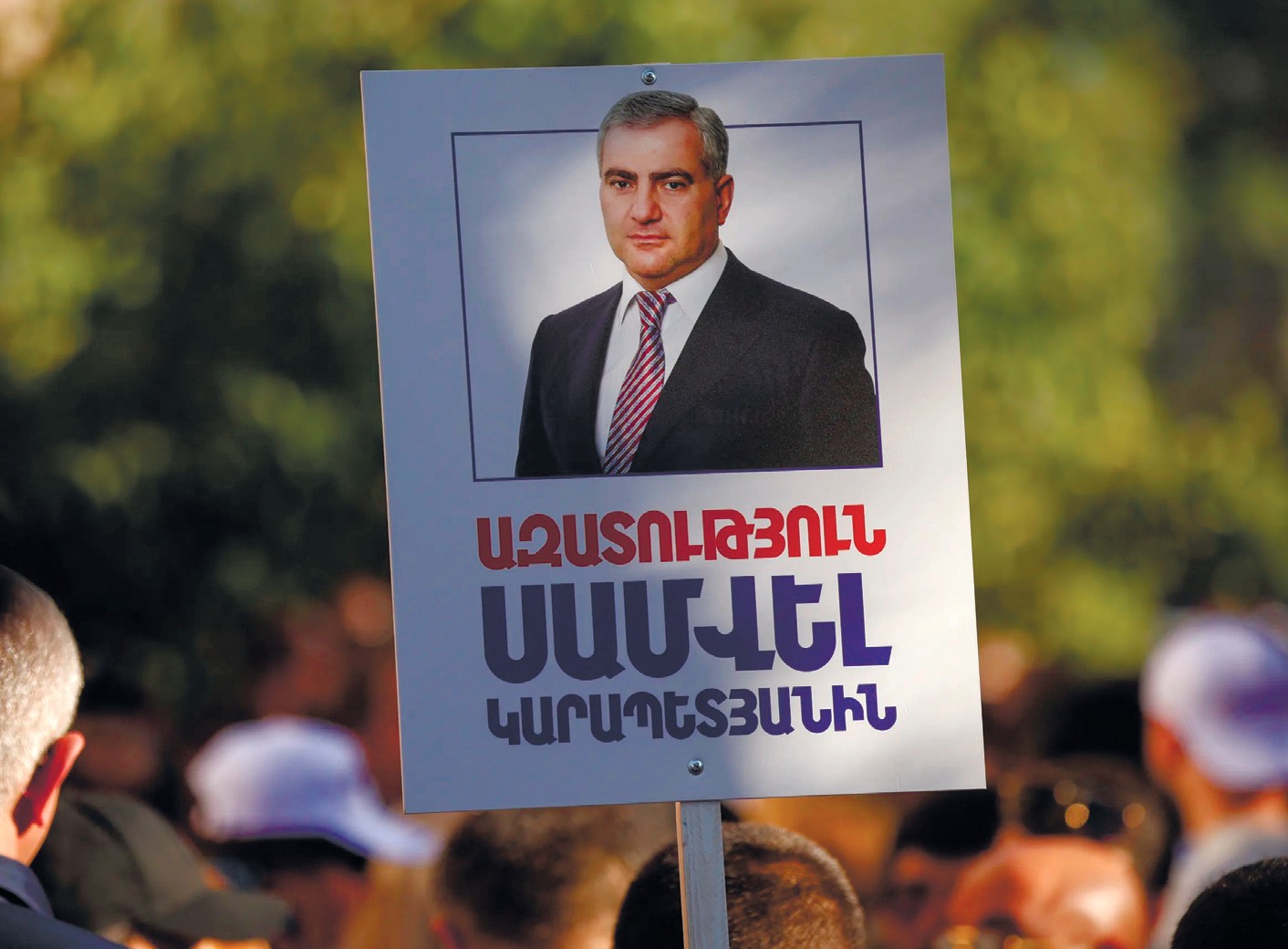
The Garabagh Clan remains the second "centre of influence". While the criminal dictatorship they established has become utterly loathsome to Armenian voters, the Garabaghists still command sufficient support, particularly within the security forces. Furthermore, they can rely on the support of semi-official paramilitary organisations that continue to operate in Armenia and which Pashinyan has not dared to disarm. However, the most serious and unpleasant surprise for Pashinyan could be a party with the pretentious name Strong Armenia, which is being established for Samvel Karapetyan. Since Karapetyan is under arrest, his nephew, Narek Karapetyan, will currently lead the electoral list.
Project "Ivanishvili": Attempt No. 3
By all accounts, this represents the greatest danger to Nikol Pashinyan. It is hardly necessary to reiterate that Samvel Karapetyan is a Russian oligarch of Armenian descent and the owner of the Tashir Group. Until recently, he also owned Armenia's electricity grids. Pashinyan has ostensibly nationalised them, but the transition has not been smooth. Armenia has faced a shortage of generating capacity for years, and the local electrical infrastructure is significantly dilapidated. Even when the Armenian power grids were directly owned by Russia, without the Tashir Group as an intermediary, experts warned that urgent measures were needed to avoid a return to rolling blackouts. So far, this has been avoided, and by nationalising the grids, the incumbent Prime Minister believes he controls the "switch". Nonetheless, there is no doubt that Karapetyan retains many of his own people within the management and staff of the electricity networks.
More significantly, he is an obvious candidate for the role of the "Armenian Ivanishvili". After the failure of Karen Karapetyan in 2018, Moscow has not abandoned the implementation of the "Ivanishvili" project in Armenia. By many accounts, Ruben Vardanyan was the next candidate chosen for this role; the plan appeared robust and foolproof. The Kremlin’s oligarch-provocateur was supposed to first revive the separatist project in Garabagh, execute a revanchist programme, and then launch a political assault on Yerevan from the "Garabagh bridgehead". However, the outcome was exactly the opposite: the anti-terrorist raids put an end to hopes of revenge, and Vardanyan himself ended up in a Baku prison, where he is now serving a 20-year sentence with little hope of early release. Now, Moscow is pulling a new ace and a new "Kremlin candidate" from its sleeve.
This is bad news for Robert Kocharyan, who until recently was considered the Kremlin’s favourite. Financial backing and informational support—all these Kremlin levers in Armenia will now work for Karapetyan. Within the Armenian political class, talk has already begun that Karapetyan is the one who can and must unite the Armenian opposition. He is already gathering Armenian political heavyweights under his banner.
Undoubtedly, the most distressing news for the Prime Minister is the defection of Armenia's first president, Levon Ter-Petrosyan, to Samvel Karapetyan's camp. Ter-Petrosyan stated this explicitly, while simultaneously delivering a harsh condemnation of Pashinyan’s anti-Church campaign. It should be noted that Ter-Petrosyan's party, the Armenian National Movement (which later became the Armenian National Congress), is where Pashinyan began his political career. Furthermore, he was one of the organisers of the rallies supporting Ter-Petrosyan after the controversial 2008 elections, where victory was "fabricated" for Serzh Sargsyan. It was specifically for his participation in those rallies that Nikol Pashinyan was imprisoned.
While other opposition leaders will divide the electorate that already detests the incumbent Prime Minister, Ter-Petrosyan will be siphoning off potential supporters from Nikol Pashinyan, with all the subsequent consequences for the latter. This does not, of course, guarantee Pashinyan’s defeat or Karapetyan’s victory. However, the June elections could provide many surprises that the incumbent Prime Minister may find difficult to manage.
Certainly, the June parliamentary elections are an internal Armenian affair. However, if the primary confrontation unfolds between supporters of Pashinyan—who, albeit by necessity, is promoting a peace agenda—and the revanchists, this directly affects the interests of Azerbaijan. Baku is naturally interested in Armenia fulfilling its obligations within the framework of the peace process. The politicians who comprise a significant portion of the revanchist camp have never been known for their scrupulous adherence to commitments. They could provide many unpleasant surprises—but for whom? Armenia is far more interested in a peace treaty than Azerbaijan, and it would be for the best if Armenian voters realise this in time.
RECOMMEND:
 166
166

