
SPACE OF INTUITION
Emin Gahramanov: "God's hand is always the guiding vector in any creative work"
Author: Tatiana IVANAYEVA
Modern Azerbaijani painting is a dynamic field that is evolving rapidly, combining classical techniques with bold experimentation. One of the most prominent figures in this movement is the contemporary Azerbaijani artist Emin Gahramanov. His work represents a territory of constant exploration, devoid of the dictates of finished formulas; instead, compositions are born through doubt, destruction, and painstaking creation. This is where art moves beyond mere visual replication to become a medium for capturing and documenting states of consciousness, transforming the canvas into a nexus where different eras and influences converge. In his hands, well-known forms are given new interpretation through the lens of spontaneous exploration, and traditional academic standards engage in a constructive exchange with experimental methods.
In his works, he does not merely aim to paint a subject. Instead, he creates an emotional framework. In this context, the use of multilayering, whether through the combination of acrylic, oil, and paper or the layering of meaning within ornamental structures, serves as a tool for penetrating the essence of things. This painting requires the viewer to engage in contemplation, as it aims to decipher a symbolic series where every curve of a pattern acts as a pulse, transmitting the artist's energy. Gahramanov's work is situated at the intersection of various disciplines, and his "ornamental decorativeness" is not merely an aestheticisation for its own sake, but rather an endeavour to identify a universal language that is understood at a subconscious level.
In our conversation with the artist, we explored the origin of the connection between matter and spirit, the overcoming of material resistance, and the perpetual nature of the search.
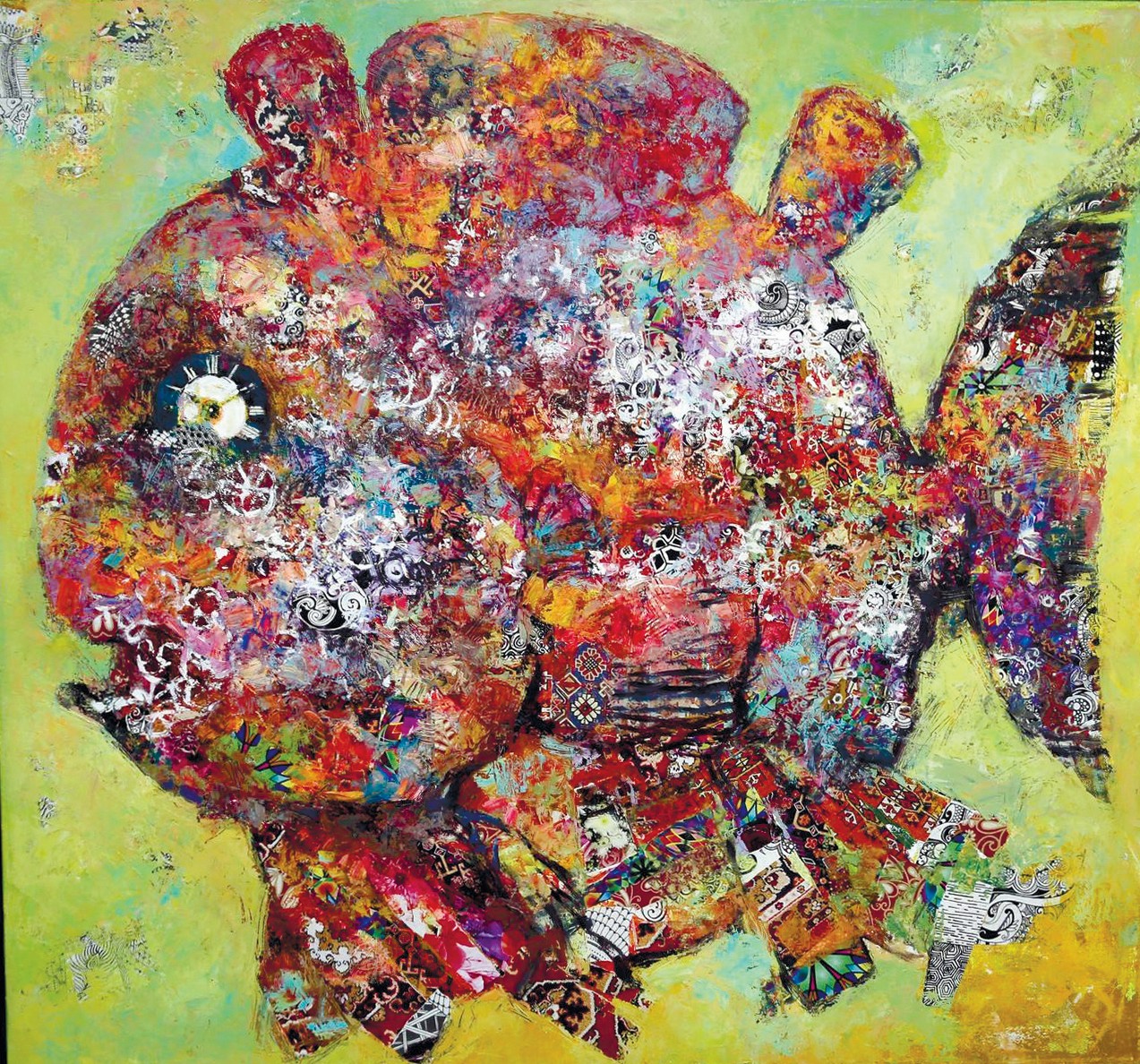
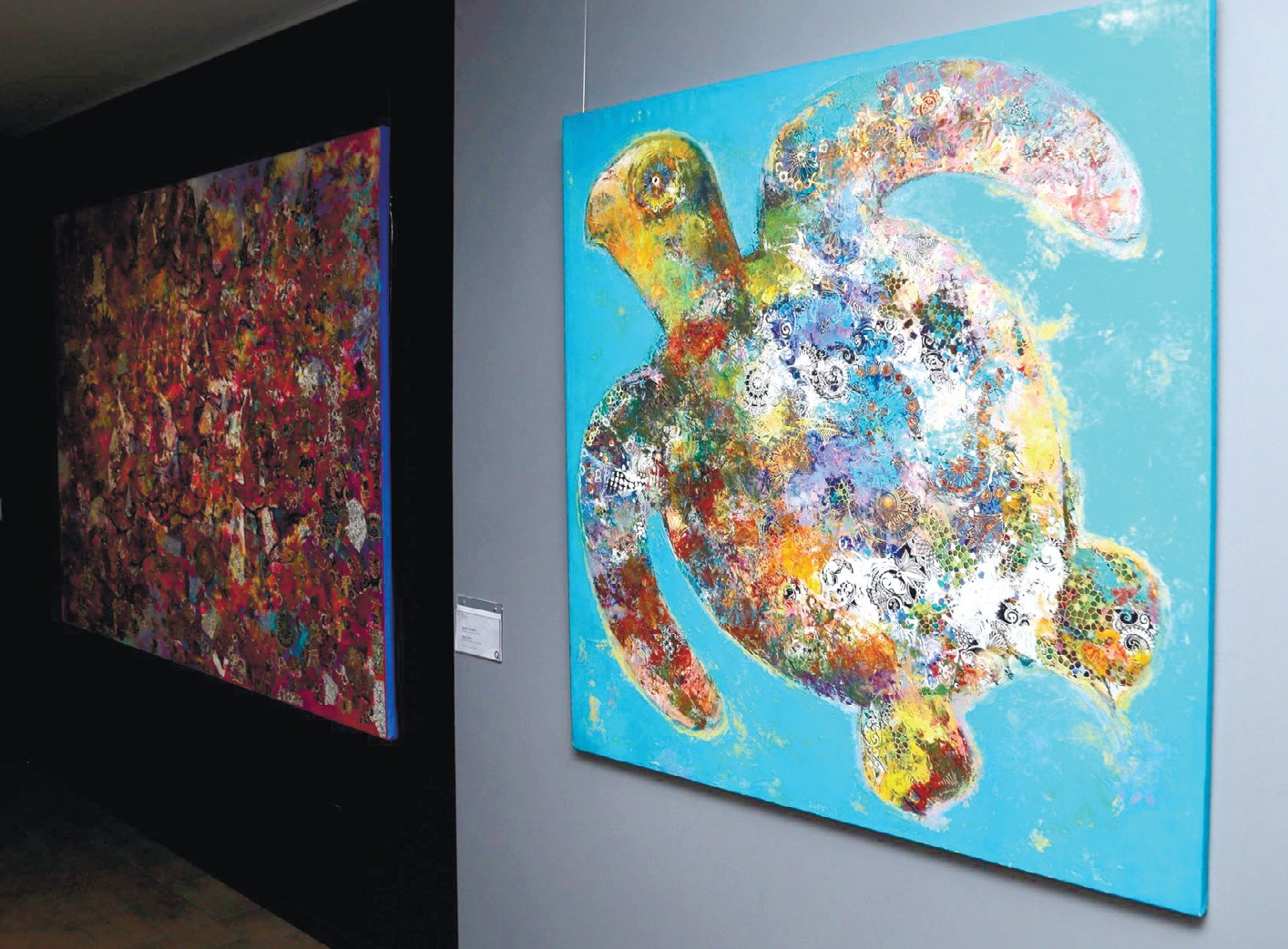
"The style in which I work today is defined in my personal classification as ornamental decorative painting. In Europe, however, such work is categorised as mixed media. This involves blended techniques and various materials: glue, acrylic, paper, and oil. I should mention that very few people use paper and oil together, as you cannot glue paper over oil. There are certain secrets involved here. One must know how to mix them correctly so that they endure for decades. It took me about four years of experimentation to achieve that specific result. But the technical side is only one aspect—an assistant could handle the mixing and gluing. When it comes to the oil, however, deciding what to retain and what to remove is where the 'higher powers' intervene: arranging the colours and, subsequently, adding sort of 'secret ingredients'."
"And how do you 'remove' unsuccessful approaches on the canvas then?"
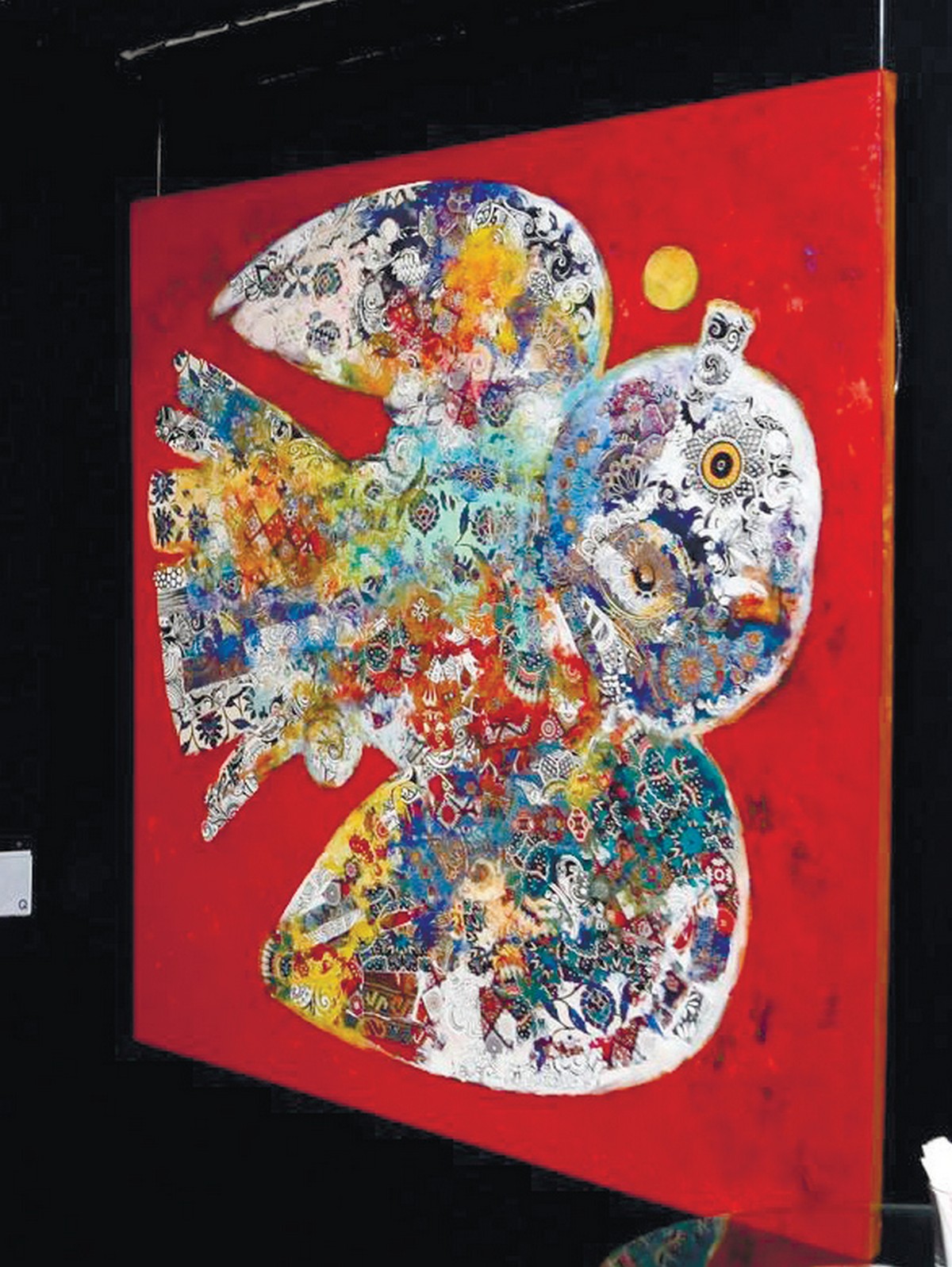
"In the same way as always. If something appears not to be quite right, I have a full twenty-four hours to remove the oil paint or take off the paper. I can paint over an ornament and lay another one on top. It is a game: colour versus ornament. A kind of mosaic. But it is not without challenges for the artist. The issue is that an ornament is a graphic drawing. I have blended graphics with painting, which is actually quite difficult—understanding which parts of, say, a flamingo should be rendered graphically and which should be more painterly. This is where our academicism steps in, suggesting where a graphic patch or a painterly one will fit organically. Combined, they must harmonise—both in colour and in drawing. You cannot overdo the graphics or the oil. It is complex, interesting, and intriguing. To an outsider, it might even look incredibly easy. However, it requires years of practice. To complete one work, I had to discard about fifty. For those who visit my studio periodically, it sometimes seems as though I am not working, as there are no new paintings there. In reality, I am simply searching for ways to express visual possibilities. For example, there is an owl that 'ripened' for three years, and it only gained 'flesh and blood' for the COLORET ANIMA exhibition series. This is because an artist is always experimenting in the studio."
"Is the search for new formats a reflection of boredom?"
"I am never bored. I am always interested. It is just that once something has been discovered, it is tucked away into my personal baggage. Yes, my work has transitioned through Modernism, the avant-garde, abstraction, and several other styles. For me, it is academic painting that is boring—pure, correct, classical work. Why is that? I do not need to compete with the world's recognised greats! I simply need to be myself and remain in a state of constant search without discarding my previous experience. Just as the Sumerians invented the wheel, artists of the past had already devised everything long before modern painting. We become acquainted with their works as we grow from children into young adults. All that remains for us is to take something from all the masters and transpose it into our own work through our own vision, listening to what descends upon the artist—inspiration, which undeniably has a divine origin."
"You often mention the presence of the Almighty in the creative process..."
"Well, I believe God's hand is always the guiding vector in any creative work. Very often, I notice that my hand works of its own. My brain might be occupied with something entirely different at the time, yet my hand performs specific functions. It is as if energy passes through the crown of my head, through the right hemisphere into my heart, and then rushes into my right hand. The left side of the brain, meanwhile, is always distracted by thoughts of taking a break. All the while, visual contact with form in all its manifestations works without interruption—be it architectural buildings, domestic carpets, tombstones, or museum exhibits. To me, they are all form in various guises. But there are moments when one can get stuck while working on a painting. It just does not work, no matter how hard you try! And then, suddenly, a portal seems to open; 'divine light' is poured upon you, and your hand leads you out of that state."
"A touch of the universe..."
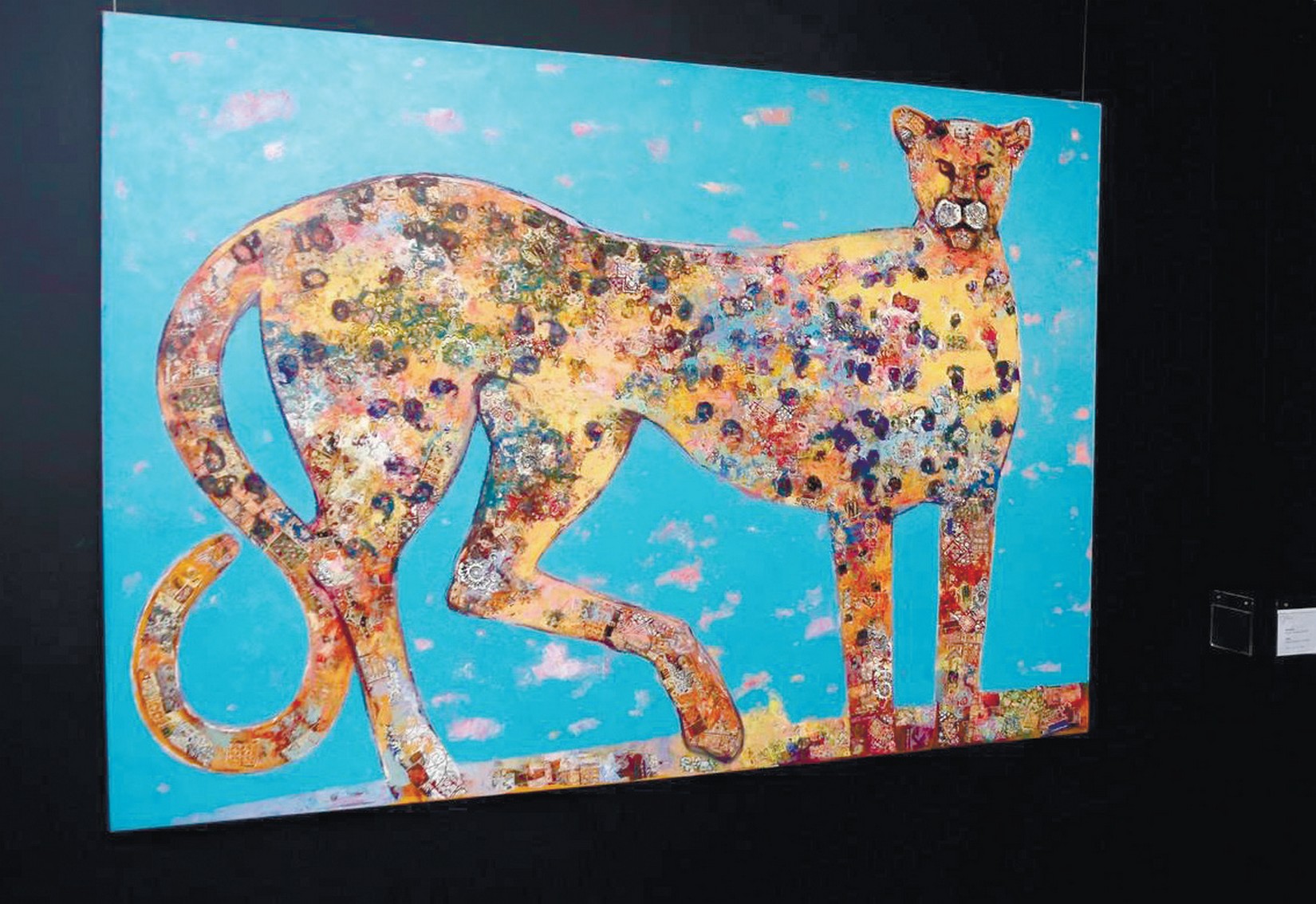
"Everything influences us, and the artist even more so! For instance, carpet weavers pull something from the subconscious that later forms into patterns. Even if most of us cannot read these messages, we understand the underlying picture on an intuitive level. In reality, a carpet pattern is a symbol which, unlike a specific word with its personalisation, is distinguished by a more extensive meaningful content, the sacredness of which is undeniable. Moreover, identical examples are found in many world cultures. That is probably why I fell under their influence, weaving patterns used by different peoples into my works from the COLORET ANIMA series."
"This series has again emphasised that form remains the main component of your work."
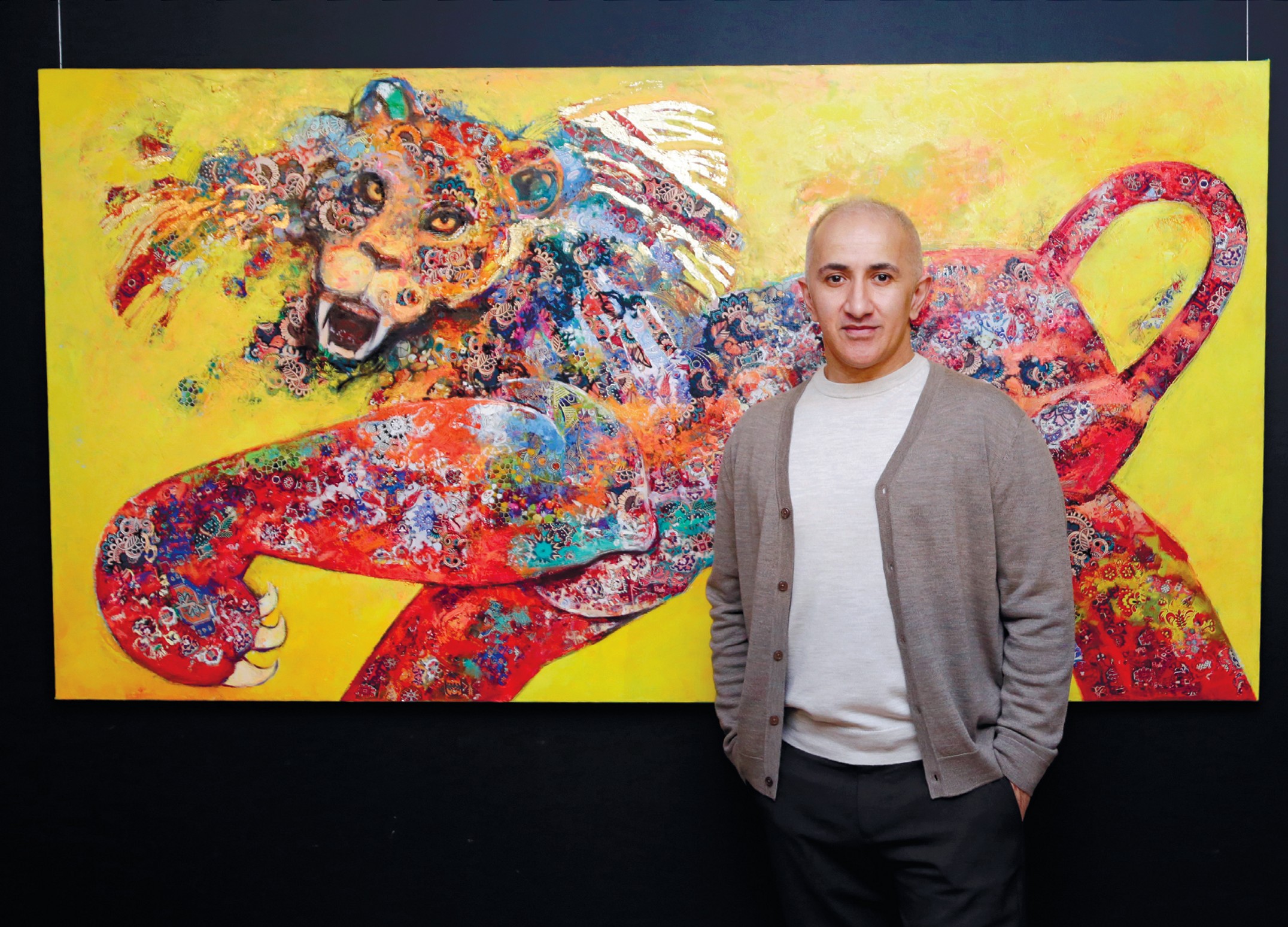
"Every animal depicted in the COLORET ANIMA series is not merely stylised. Here, I consciously moved away from detail, cutting away everything unnecessary and leaving only the form. And the feeling for it comes, as it were, from above. From nature, from the cosmos... The process of reproducing a form on canvas is passed through the heart and soul, where every line is drawn with a specific meaningful designation. For example, the shape of a bird is also a certain symbol. In fact, both the birds and the animals in this series have specific meanings: the lion (though in my case it turned out to be a 'tiger-lion') represents strength and power, the owl represents wisdom, and the fire horse represents energy and swiftness. It is like a spiral unwound by symbols."
"But there are still the requirements of the classical approach..."
"I do not dispute that, but in my case, it happened outside of formal study. I recognise that the academic school of painting is mandatory for a true artist. I realise that there are those today who deny its importance. But notice: there are very few true draughtsmen among contemporary artists. Although they can create quite good works, one still senses the absence of a 'foundation' in them. I will not deny that academic education has a side effect—it tends to erase the conditional memory of a child. It is quite difficult to preserve what was originally placed in you by God while combining it with the technical 'sciences' acquired during the educational process, which include composition, perspective, and so on. If you manage to do this, the result is a collection of decent works with an original signature, including those 'reference points of individual memory'. In my case, these became an appeal to patterns. Incidentally, traditional carpet patterns piqued my interest in those found in the cultures of other nations—for example, Indian, Slavic, and Islamic traditions. Combining them into a single 'space' is not easy, but this is exactly where the 'rules of the academy' come into play. The very ornaments that have filled the space of my canvases today are combined largely by intuition, resting upon a classical foundation."
"Can we argue that your method is based exclusively on your own self?"
"The statement 'I work for myself' has long since become a meme. In my view, it contains a certain duality of ambiguity. Even using myself as an example: while I paint works according to the desire to realise my personal 'thoughts as an artist', I want to show them to people. And since there is such a need, and people are waiting to be introduced to something new, and you have something to offer, then you must exhibit. After more than a decade of exhibition activity, I can assert this because I have tried not to repeat myself. I adore mixes. But turning to patterns and ornaments in my work has become, at least for now, an avenue of unlimited possibilities for visual research. At the same time, I strive not to lose my deeply individual essence, which brings me back to my personal roots..."
"...While reserving the right to be replenished from the outside?"
"I have already noted that influence is inevitable. When you are abroad, you realise that visiting museums and galleries is essential. Whatever 'catches' me and piques my interest, I certainly include in my personal baggage as an artist. I do not think twice when I stand before a canvas, and I do not begin working with the intention of being liked. Rather, the trigger is an interest in something at a 'wow!' level, and I rush to transfer that energetic message onto the canvas. It makes no difference to me which culture gave birth to that 'wow!' moment. In general, for an artist, the concept of 'national belonging' is negated, dissolving into the working process. To think and seek connections regarding where the narrative component of a painting originates is somewhat absurd. The most important thing is creativity..."
"...Which is an expression of freedom..."
"Exactly! In the true sense of creativity, there is only one vertical—Man and God. When I pick up a brush or a palette knife, I do not think about who I am or what I truly am. There is a total dissolution into what I transfer onto the canvas from what I have received from above, passing it through my own inner world, which is free from any frameworks, restrictions, or conventions."
Emin Gahramanov's solo exhibition, COLORET ANIMA, which was held in April at the Qız Qalası gallery, was the result of a deep personal search. A series of works was presented that did not copy the external world but were intended to embody a state of the soul. The viewer was immersed in a space where colour and ornament enter into a tense dialogue, and form becomes the meaningful centre. This exhibition was the quintessence of Emin Gahramanov's many years of creative development, where each painting, like a puzzle, fits into a single mosaic of the artist's vision of the universe.
RECOMMEND:
 144
144