

THE FINE-TUNING POLICY
What signals does the stability of the CBA’s discount rate send to Azerbaijan’s economy?
Author: Ilaha MAMMADLI
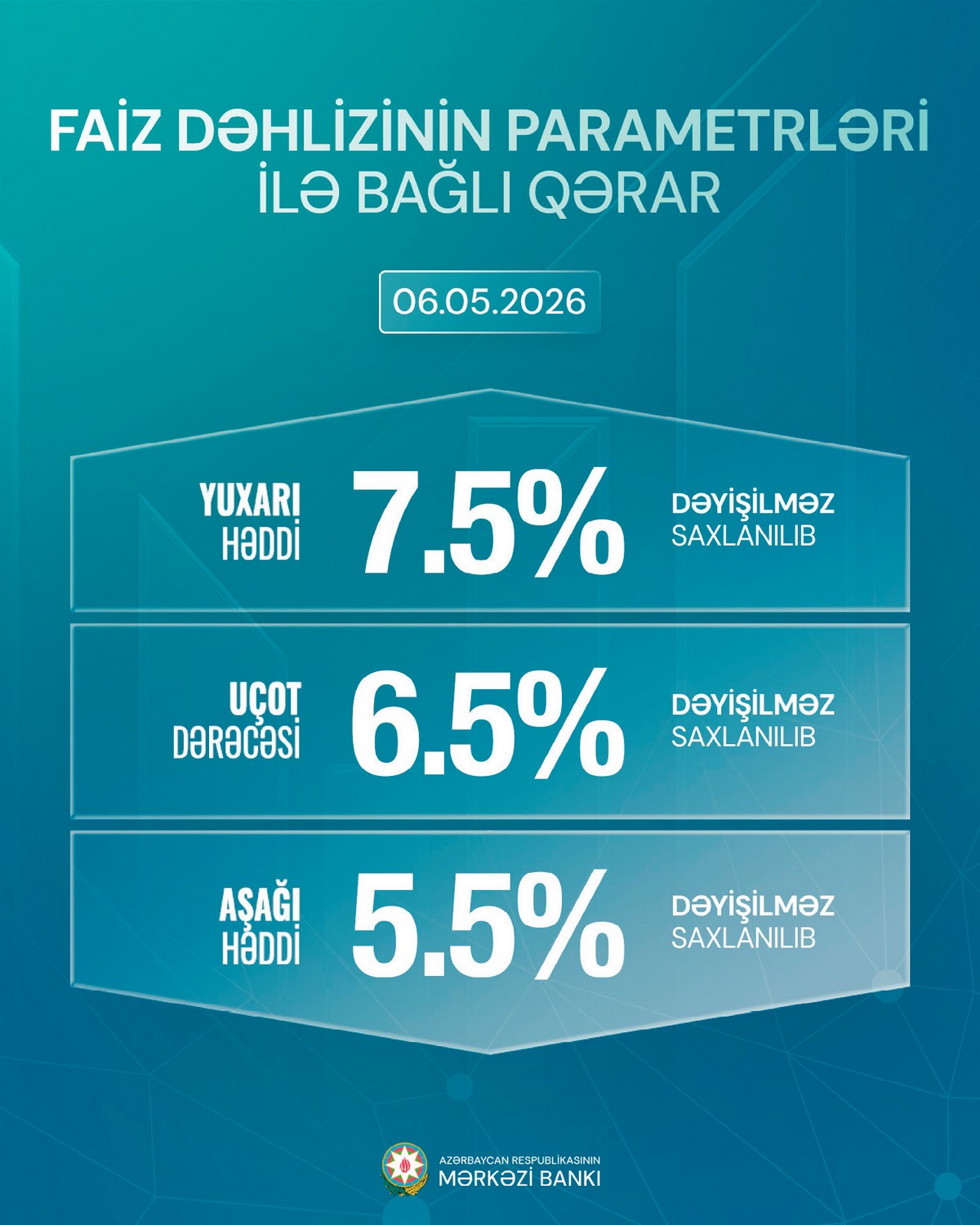
The Central Bank of Azerbaijan's recent decision to maintain the discount rate at 6.5% sends a clear signal to the financial market and the broader economy. In the face of ongoing global economic uncertainty, the regulator has indicated a shift in policy, suggesting that the period of active monetary easing is transitioning to a more cautious phase.
Furthermore, the CBA has left the discount rate and the parameters of the interest rate corridor unchanged. The lower bound remains at 5.5%, and the upper at 7.5%.
The current rate is at its lowest for four years and is close to the point where monetary policy neither exerts excessive restraint on the economy nor stimulates overheating.
Transmission mechanism
Since the start of 2026, the interest rate corridor parameters have been discussed on three occasions. Following two meetings where the rate was kept unchanged, the Central Bank decided to cut it by 25 basis points in February, bringing it to the current 6.5%. Following this, the regulator took a brief pause to assess the sustainability of inflation processes and the impact of external factors on the domestic economy.
In its statement, the CBA emphasised that the decision was made considering actual and forecast inflation, global financial conditions, geopolitical risks, and the efficacy of transmitting monetary decisions to the real sector of the economy. This is a key challenge for Azerbaijan's monetary policy today.
Despite the easing of inflationary pressure, international financial institutions believe that the scope for further policy easing remains limited. Fitch Ratings notes that the monetary policy transmission mechanism in Azerbaijan is still in the formative stage. According to the agency, the high liquidity of the banking sector and the persistent level of dollarisation in the economy serve to weaken the impact of the discount rate on the cost of credit and economic activity. As of the end of 2025, deposit dollarisation stood at 36.8%, although this indicator is gradually declining.
Fitch Ratings considers the likelihood of further rate cuts in 2026 to be low. At the same time, the agency has a positive view of the Central Bank's steps to develop domestic financial instruments and improve the methodology for calculating the AZIR overnight rate, which in the longer term should enhance the effectiveness of monetary policy.
Analysts at ING Group anticipate a less robust scenario. Market analysis suggests that the CBA will maintain the rate at 6.5% in Q2 2026, with a potential reduction to 6.25% in Q3, followed by a further cut to 6% in Q2 2027. Fitch Solutions shares a similar view, expecting a gradual reduction in the rate to 6% by the end of this year.
The prospects for further easing depend directly on inflation dynamics and the external environment. One of the key risks remains a possible rise in global oil prices against the backdrop of tension in the Middle East. For Azerbaijan, this creates a twofold effect: on the one hand, export revenues increase; on the other, inflationary pressure intensifies.
That is precisely why the International Monetary Fund (IMF) recommends that the Central Bank remain ready to tighten policy in the event of an acceleration of inflation. According to the IMF, inflation in Azerbaijan could reach around 6% in 2026, which remains a sensitive level for monetary stability.
Of additional significance for Azerbaijan is the policy of the world’s major central banks. The US Federal Reserve also kept its base rate at 3.5–3.75% in late April 2026, demonstrating caution amid persistent global inflation risks.
For Azerbaijan, this creates a relatively comfortable external backdrop. Maintaining a stable spread between the Fed and CBA rates helps to preserve the attractiveness of manat-denominated assets and eases pressure on the foreign exchange market.
Domestically, the Central Bank’s current policy is already contributing to a more stable macroeconomic environment. Inflation remains under control, the banking system maintains high liquidity, and credit activity is gradually adapting to the new cost of money. Nevertheless, the regulator is clearly avoiding an overly rapid shift to loose monetary policy. Against the backdrop of global instability and persistent external risks, the CBA will most likely continue to adhere to a cautious approach, favouring gradual and well-calibrated decisions.
Between inflation and supporting the economy
The Central Bank’s updated macroeconomic forecasts show that the regulator is assessing the economic outlook ever more cautiously amid mounting external turbulence. While as recently as February the CBA expected GDP growth of 2.4% in 2026, it now expects just 1.1%. At the same time, non-oil and gas sector growth has been revised down from 4% to 3.2%. Yet the very fact that the non-oil sector is maintaining positive momentum remains an important indicator of the structural resilience of Azerbaijan’s economy.
For 2027, the CBA expects an acceleration in economic growth to 3.2%, with the non-oil and gas sector expanding to 4.7%. This shows that the regulator views the current slowdown more as a temporary phase of adaptation to global risks than as the start of a long-term downturn.
It is particularly noteworthy that, alongside the revision of economic growth, the CBA significantly raised its expectations for world oil and gas prices.
At first glance, such dynamics should have improved the economy’s prospects, given the major role of the energy sector in Azerbaijan’s export earnings and budget revenues. However, the paradox of the current global situation is that the rise in energy prices is accompanied by heightened inflation risks and worsening world trade conditions.
It is precisely this factor that CBA Chairman Taleh Kazimov drew particular attention to. According to him, geopolitical tensions, above all the conflict in the Middle East, have amplified the impact of external inflation drivers through disrupted supply chains, higher transport and insurance costs, and increased volatility on global energy markets.
In effect, Azerbaijan is today facing the classic effect of imported inflation, where a significant portion of price increases is generated not domestically but from abroad—through the rising cost of goods, logistics and inflationary processes in trading partner countries.
It is no accident that the CBA raised its inflation forecast for 2026 from 5.5% to 5.9%, and for 2027 from 4% to 4.5%. It also points out directly that supply-side factors, not domestic demand, are becoming the main driver of inflation.
Mr Kazimov stressed that inflation in trading partner countries has already exerted an upward influence on domestic prices in Azerbaijan to the tune of 2.79 percentage points. Additional pressure came from the rise in agricultural producer prices, the impact of which is estimated at a further 1.78 percentage points.
At the same time, the head of the Central Bank noted the important role of the stable manat exchange rate as the main anti-inflation tool. Thus, the 4.6% appreciation of the nominal effective exchange rate of the manat in March compared to the same period last year helped to reduce inflationary pressure by around 1 percentage point. This acted as a kind of shock absorber against the backdrop of rising external inflation.
Moreover, the CBA head effectively indicated that the regulator is not considering a shift to a different exchange rate model for now. As Mr Kazimov put it, the Central Bank has “neither any intention to change the regime, nor any reason to do so”, and maintaining a stable exchange rate remains a key element in ensuring macroeconomic stability.
This stance is particularly telling under current conditions, when many emerging market economies are grappling with high volatility of their national currencies and accelerating inflation.
External environment
Despite the revision of inflation forecasts and the slowdown in economic growth, the Central Bank’s latest estimates show a marked improvement in the balance of payments and foreign exchange market positions.
According to customs statistics, Azerbaijan’s foreign trade surplus already reached $1.4 billion in the first quarter of 2026, immediately exceeding the figure for the same period last year by 93.3%. This reflects not only the favourable pricing environment on global energy markets but also the gradual expansion of non-oil exports, on which the authorities have been placing a strategic emphasis in recent years.
It is precisely the combination of these factors that enabled the Central Bank to significantly improve its forecast for the current account of the balance of payments. While as recently as February the CBA expected a current account surplus of $2.8–3 billion in 2026, it now expects nearly twice that—up to $5.5 billion. Expectations for 2027 have also been revised upwards, to $4.4 billion.
The CBA chairman directly linked this revision to the rise in prices of Azerbaijan’s main export goods and the continued strengthening of non-oil exports.
It is especially telling that, against the backdrop of persistent global risks, Azerbaijan’s foreign exchange market is showing signs of a steady surplus of foreign currency supply. This has already led to a situation quite unusual in recent years: in March–April the CBA did not hold any currency auctions at all. As Mr Kazimov explained, the reason was that supply exceeded demand on the currency market. Moreover, in April the Central Bank itself was forced to enter the market with an intervention to purchase foreign currency in the amount of $1 billion.
According to the CBA head, de-dollarisation processes in the country continue to strengthen. In March, the dollarisation level of resident individuals’ deposits fell to 28%, which is 2.1 percentage points lower than the previous year’s figure.
The decline in dollarisation is becoming one of the key indicators of growing public confidence in the national currency and the stability of macroeconomic expectations. The current situation may persist in the coming months.
An important indicator of the changing structure of the foreign exchange market is also the decreasing dependence of banks on the Central Bank’s currency auctions. Demand for foreign currency still exists, but banks are increasingly meeting it through transactions with one another on the interbank market.
A new challenge for the Central Bank
At the same time, the Central Bank continues to tighten its grip on banking sector liquidity. Despite the persistent surplus of funds in the system, the regulator is so far managing to keep short-term interest rates close to the discount rate.
According to CBA data, the average daily AZIR index stood at 6.47% in March and at 6.44% in April—in other words, it practically coincided with the current discount rate of 6.5%.
This is particularly important in the context of the growing excess liquidity in the banking sector. Whereas at the end of 2025 it stood at ₼2.9 billion, by the end of April of the current year it had already reached ₼3.8 billion.
As Mr Kazimov stressed, the Central Bank, using monetary policy instruments, has managed to keep the reference rate near the target level. Up to 89% of liquidity sterilisation operations were conducted through weekly deposit auctions.
In essence, the CBA is now simultaneously tackling several complex tasks: it is curbing imported inflation through a stable exchange rate, controlling excess liquidity, maintaining confidence in the manat, and at the same time trying not to allow the economy to cool excessively.
It is for this reason that the regulator’s current policy increasingly resembles a model of ‘fine-tuning’, where the main objective is not an abrupt change in the parameters of monetary policy but constant balancing between external shocks, domestic inflation, exchange rate stability and support for economic activity.
RECOMMEND:
 112
112

