

CODE OF FINANCE
Digital technologies become the basis of new banking model and regional integration
Author: Ilaha MAMMADLI
The financial sector is currently experiencing one of the most significant transformation phases in recent decades. The integration of artificial intelligence (AI), money tokenisation, biometric identification, open banking and instant payment systems (IPS) is progressing from experimental solutions to becoming fundamental components of a new economic reality.
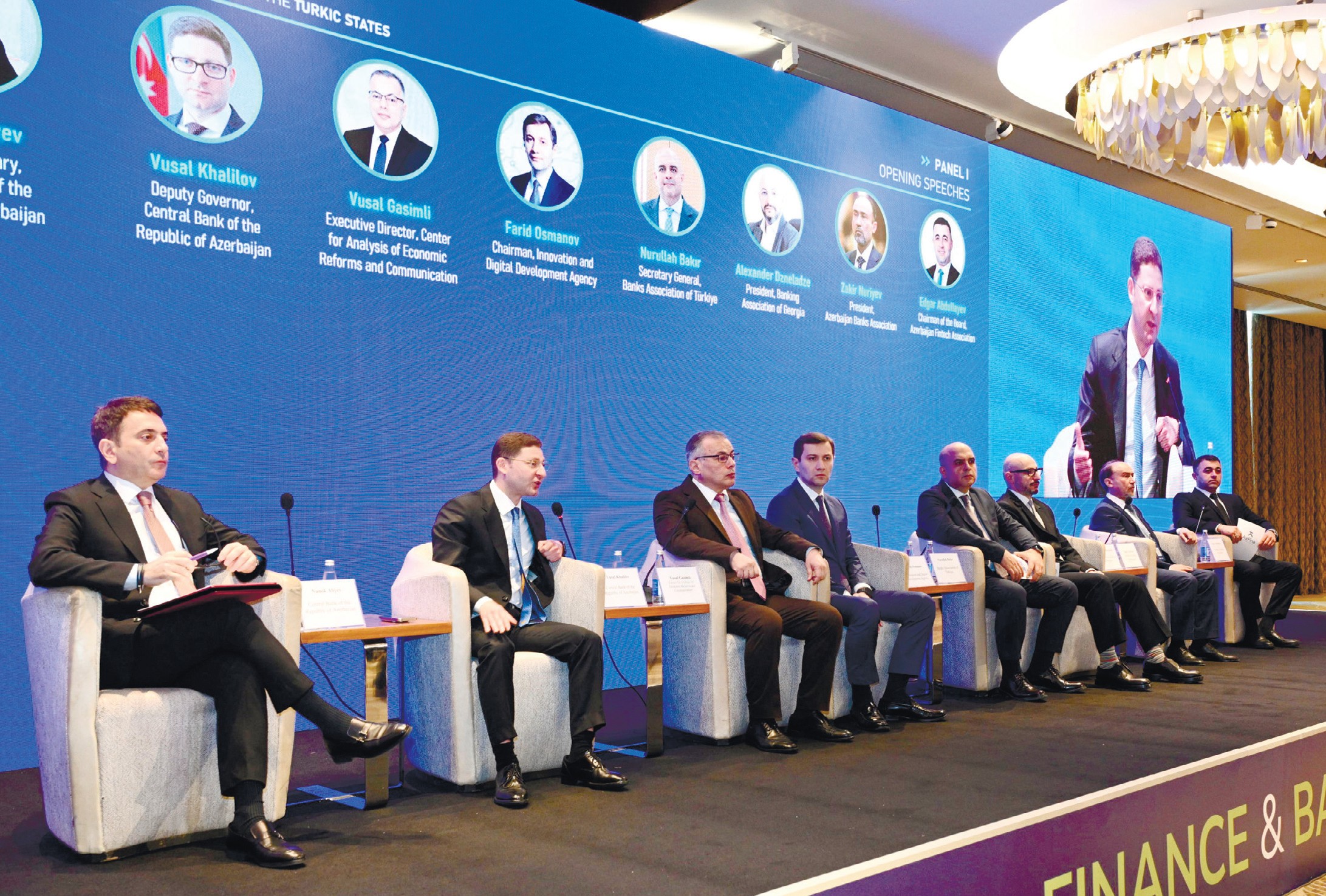
These processes were central to the 10th International Financial and Banking Summit, held on June 9-10 in Baku.
In the business world, digital transformation is almost always associated with broader objectives. These include the creation of a unified financial space, the expansion of investment opportunities and the enhancement of the resilience of regional economies in the face of increasing global competition.
A new financial roadmap
Within the Organisation of Turkic States (OTS), a notable situation is emerging: the region's economic potential significantly outpaces the development level of its financial system.
The combined GDP of OTS countries has already surpassed $2.1 trillion, accounting for approximately 3% of the global economy. Furthermore, these states have demonstrated robust growth rates: last year, Kyrgyzstan's economy expanded by over 11%, Uzbekistan's by more than 7%, and Kazakhstan's by over 5%. The average growth rate across OTS exceeded 6%, significantly outperforming global averages.
However, despite this impressive dynamic, the banking sector still lags considerably behind the region's economic scale.
According to Vusal Gasimly, Executive Director of the Centre for Economic Reform Analysis and Communication, the total banking assets across OTS amount to around $1.2 trillion, or just 0.8% of global banking assets.
"When comparing banking assets to GDP, it becomes evident that OTS' share in the world economy is almost four times greater than their share in the global banking system. This indicates enormous potential for developing financial intermediation," he noted.
In other words, regional economies are growing faster than the financial infrastructure that should supply this growth with necessary investments and credit resources.
As indicated by the latest savings figures, this is also confirmed. Gasimly explained that savings across OTS have already reached $670 billion, equivalent to 2.3% of global savings. However, a significant proportion of these funds have not yet been converted into investments and loans at a sufficient scale.
The expert anticipates that this discrepancy between accumulated savings and banking system development will generate significant opportunities for expanding credit provision, deepening financial markets, and creating new capital attraction instruments. Thus, forming a closer financial space among Turkic states is not only a political initiative but also an economic necessity capable of unlocking the potential of one of Eurasia’s most dynamically growing regions.
The future of financing
Farid Osmanov, Chairman of the Agency for Innovation and Digital Development, has reported that Azerbaijan is finalising a substantial legislative package intended to accelerate the adoption of digital technology.
The country has set itself ambitious targets: by 2030, it aims to double the size of its ICT sector and increase digital services exports sevenfold to $1 billion per year. Mr Osmanov emphasised that Azerbaijan's goal is not only to accelerate domestic digitalisation, but also to establish itself as a regional centre of digital and technological excellence.
As Nurullah Bakir, Secretary-General of the Association of Banks of Türkiye, has observed, digital banking in the Turkic world is experiencing rapid growth.
He cited Türkiye's banking system digital transformation as an example: the number of active digital banking users grew from approximately 51 million in 2019 to over 129 million today—more than doubling. Mobile banking usage saw a significant surge, with a growth rate of approximately 200%. The speaker asserts that this demonstrates that digital financial services have become an integral part of citizens' daily lives.
Open banking and modern payment systems play a special role in further financial sector development by allowing clients to manage accounts from different banks through unified platforms.
However, as digital services expand, so do the cyber threats to which they are exposed. He emphasised that regional cooperation on cybersecurity, threat information exchange, and joint protection mechanisms could significantly enhance the resilience of the banking sector.
Alexander Dzenadze, President of the Georgian Banks Association, reiterated this point. He argued that no single country can independently cope with the scale of ongoing change and expressed Georgia's support for initiatives aimed at developing trade, investment and strengthening links between regional financial markets.
Mr. Zakir Nuriyev, President of the Azerbaijan Banks Association, emphasised the necessity to establish an innovation centre that would encourage the adoption of new technologies and define priority development areas for the sector. He proposed the establishment of such a centre under the CBA (Central Bank of Azerbaijan).
Another key direction he identified is the development of NFC-based digital payments within instant payment systems. This would make transactions more convenient, faster and accessible while accelerating innovation adoption in the national payment ecosystem.
Nuriyev is convinced that the advancement of modern payment technologies will underpin closer integration of regional financial markets. "Cross-country financial integration is a strategic step that must be taken today. Digital transformation, joint financial infrastructures and innovative solutions have the potential to strengthen our region's position within the global financial system," he emphasised.
He believes that achieving this requires not only technological solutions but also closer coordination among states. In particular, he proposed the establishment of joint working groups comprising central banks and industry experts with a view to developing instant payment systems, sharing technologies and mutually recognising innovative solutions.
He cited international experience as a successful example, highlighting the long-standing operation of integrated payment mechanisms such as SEPA and TARGET2 in the European Union, which ensure efficient cross-border settlements. A similar process is underway in Southeast Asia, with Thailand, Singapore, Malaysia, Indonesia and Cambodia working together to create a unified digital payment ecosystem.
Nuriyev has confirmed that the Turkic states have already taken significant steps in this direction. The implementation of regulatory improvements in payment services, the drafting of legislation on digital banks, the establishment of legal frameworks for cryptocurrency, the introduction of instant payment systems and the expansion of innovative services will provide a solid foundation for further financial development.
Azerbaijan's IPS performance is a particularly noteworthy indicator of this success. Tofig Ajirgayev, Chief Software Engineer at CBA, reported that over a five-year period transaction numbers in the system had increased 86-fold, with growth rates remaining at record-breaking levels in 2026.
The next development stage could see the system expand beyond national borders: Azerbaijan is currently engaged in negotiations with Türkiye and the UAE regarding the establishment of a cross-border instant payment system.
Another key benefit of introducing IPS has been a reduction in financial service costs. QR payments and other digital tools have been shown to contribute to a significant reduction in transaction expenses for both banks and their customers.
Use of AI
The summit discussions were also very productive, with a focus on AI, which is now widely recognised as one of the main drivers transforming finance.
However, Mahir Guluzade, Head of Data Engineering at CBA, noted that the main obstacle to effective AI adoption is not algorithms or computing power but data quality.
"It is imperative that data is comprehensible to the system. This necessitates the implementation of a dedicated semantic layer to facilitate effective interpretation of information by AI systems," he explained.
Ruslan Vdovichenko of Freedom Holding has expressed concerns that the conclusions of AI systems may gradually be viewed as more authoritative than expert opinions. He cited Kazakhstan as an example of responsible regulation, where legal frameworks for AI use have been developed to clearly define accountability. This means that even when doctors use AI for diagnosis assistance, the final decision remains human-made. Legislation also imposes limits on the use of technology for analysing citizens' emotional states, collecting sensitive personal data and manipulating behaviour. Vdovichenko has stated that a similar approach could also be beneficial for Azerbaijan.
Michael Salmoni, CEO of the consulting firm Payments Innovation, delivered a presentation on the subject of tokenisation—the process of converting money and other assets into digital form using blockchain technology. He observed that tokenisation has the potential to facilitate value transfer on a global scale with the same level of efficiency as email.
At present, international transfers are primarily facilitated by correspondent banks, RTGS systems and SWIFT networks. Tokenisation provides an alternative model in which value transfer occurs almost directly between participants. "If people can send money directly just by bringing their phones close together, how will banks' role change? These institutions will continue to exist, but their function will undergo significant change," M. Salmoni argued.
The rapid dissemination of such tools has prompted regulators to establish new legal frameworks. The EU has already implemented MiCA regulation, which covers crypto-asset markets. In the US, legislative initiatives are underway to define rules for digital assets.
Cybersecurity: a top priority
In the current business environment, cybersecurity is of the utmost importance. It is a key factor in determining the resilience of the financial sector during the ongoing digital transformation.
Vusal Khalilov, a member of the CBA board, has announced that Azerbaijan intends to implement new anti-fraud regulations based on a risk-oriented approach before the end of the year. While existing mechanisms have yielded tangible results in the fight against financial fraud, it is important to note that eliminating cyber risks entirely is impossible. This is due to the fact that criminals' methods develop as fast as protection technologies do.
Therefore, the discussions at the summit demonstrated that the future of finance cannot be considered in isolation from technological developments. While many solutions are still under active development, the direction of travel is clear: tomorrow's financial system will be faster, more integrated and more technologically advanced than ever before.
RECOMMEND:
 90
90

