

DROWN IN EXISTENTIAL DISPUTE
On the disagreements over war strategy and its possible consequences for Kiev
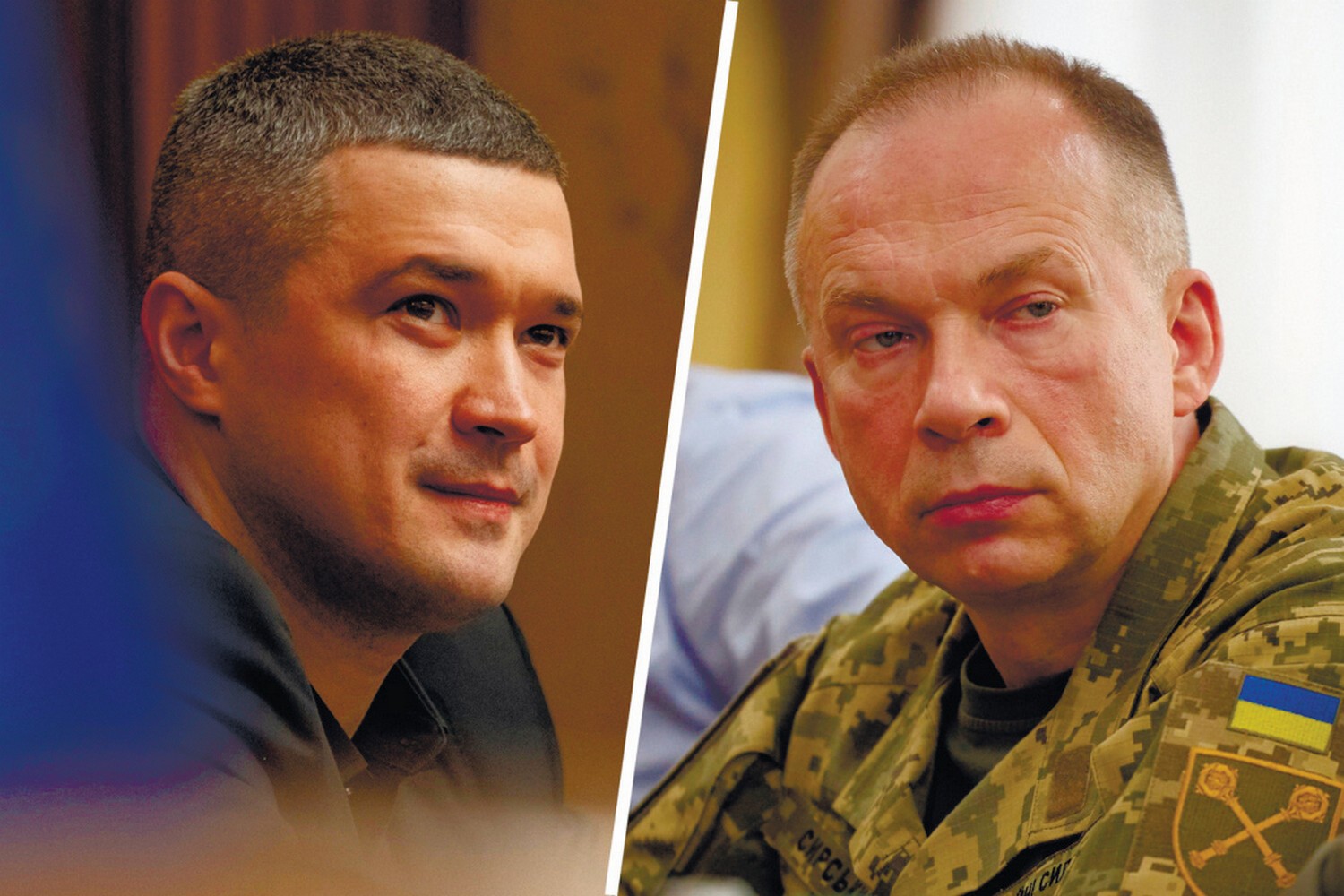
Author: Natig NAZIMOGHLU
The high-profile resignations in Ukraine have confronted the country with a series of vital questions. Will the departure of Mikhail Fedorov and Alexander Syrsky, respectively from the posts of defence minister and commander-in-chief of the Armed Forces of Ukraine, lead to a domestic political crisis, especially since both events occurred at the very moment when the old government was being dissolved and a new cabinet was being formed? Above all, how will they affect the further course of the Russian-Ukrainian war? What consequences will they have for the positions and prospects of Ukraine, which is fighting for its sovereignty and territorial integrity?
Drones vs classical defence
Ukraine found itself on the brink of a domestic political crisis at the same time as the resignation of Yulia Sviridenko’s government—a resignation that President Vladimir Zelensky explained by the “need to implement a renewed political strategy”. The new prime minister became Sergei Koretsky, head of Naftogaz. However, the new cabinet had no place for Mikhail Fedorov, who at 35 is already rightly regarded as one of Ukraine’s most authoritative and promising political figures.
Fedorov worked as defence minister for only six months. But in that relatively short period he managed to implement such large-scale changes in Ukraine’s defence policy that, as international experts believe, allowed Ukraine to seize the initiative at the front. Fedorov’s name, who had previously served as deputy prime minister and minister of digital development, became almost synonymous with Ukraine’s recent military successes, based on his championed concept of “asymmetric war” relying on the most active possible use of drones and strikes on strategic targets inside Russia—both military and energy infrastructure.
Over the six months of his tenure at the head of the Ministry of Defence, Ukraine not only managed to counter the Russian offensive but also to move the war deep into the territory of the Russian Federation.
As was anticipated, the resignation of Fedorov led to widespread protests in multiple Ukrainian cities. Even MPs from the pro-government Servant of the People party have voiced their support for Fedorov, particularly noting that "for the first time in many years, people are taking to the streets not against an official, but in support of the team and the changes he proposed".
Meanwhile, the commander-in-chief of the Armed Forces of Ukraine, Alexander Syrsky, has also been dismissed, although he is associated with a serious internal power conflict involving Fedorov—more precisely, the conflict between the Ministry of Defence and the General Staff of the Armed Forces of Ukraine, the existence of which Fedorov himself confirmed.
In the context of the recent high-profile resignations, it was revealed that during his tenure as Defence Minister, Fedorov had proposed to President Zelensky "radical personnel decisions", primarily involving the replacement of Syrsky. The commander-in-chief, for his part, insisted on Fedorov's dismissal. It appears that the conflict was rooted in a disagreement over the provision of material support for the army. The civilian head of the Ministry of Defence wished to bring this area under his own control, while the military resisted, seeking to prevent any "outside" influence on the strategic management of the war.
However, in purely military terms, two approaches to the conduct of hostilities collided. Syrsky, who is rightly credited with the heroic defence of Kiev at the start of Russia’s full-scale invasion and subsequently with organising the Ukrainian offensive in the Kharkov region and the operation in the Kursk region of the Russian Federation, gave preference to more classical methods of warfare, believing that infantry assaults in particular could secure a successful outcome. Fedorov, by contrast, is a proponent of drone-assault tactics, which was why he accused Syrsky of sabotaging the reform plans proposed by the Ministry of Defence, concerning, among other things, the organisation of combat operations directly at the front.
Deep contradictions spread through the Ukrainian leadership across the entire range of issues aimed at ultimately achieving victory in the protracted war. Some are convinced that the war cannot be won by drones alone, because, as the head of the Ukrainian president’s office, Kirill Budanov, put it, “they are not the main weapon, but support”.
Notably, the former commander-in-chief of the Armed Forces, Valery Zaluzhny, expressed himself in the same spirit, although he is considered Syrsky’s long-time rival. In Zaluzhny’s view, the vulnerable side of Fedorov’s plan is that the use of drones does not guarantee the possibility of an offensive.
However, there is another point of view that justifies Fedorov’s line. According to it, the large-scale use of drones, while not leading directly to a quick victory (and a quick victory is in principle impossible in the context of a war with Russia), does bring closer the strategic result Ukraine needs.
Zelensky’s choice
Ukraine's president was faced with a challenging decision, acknowledging that Syrsky and Fedorov had not been able to reach an agreement, a situation that had now become a matter not only for them, but for him as well. The complexity of the decision-making process ultimately led to a radical step, namely the almost simultaneous resignation of both Fedorov and Syrsky.
Instead of Syrsky, 43-year-old Major General Mikhail Drapaty, who had previously served as commander of the Joint Forces of the Armed Forces of Ukraine, was appointed commander-in-chief of the Armed Forces. Drapaty's military fame was built on the successful defence of the Kherson sector, including his major personal contribution to the operation to liberate Kherson in November 2022.
In addition, Drapaty was directly responsible for the defence of the Kharkov region, successfully preventing Russian troops from penetrating deep into the area. Following the appointment of Syrsky as commander-in-chief of the Armed Forces in February 2024, Drapaty assumed the role of deputy chief of the General Staff.
Following the resignation of Syrsky, Drapaty was appointed as the new commander-in-chief. Fedorov described this as "new air and new hope in the struggle of free people for freedom and justice" and "the voice of change that could not go unheard".
With regard to Mr Fedorov, he was offered the opportunity to continue his involvement with the ruling team as Deputy Prime Minister for Technological Development. However, he rejected Zelensky's offer and called for his own reinstatement as defence minister. This only serves to highlight the ongoing and significant differences in opinion within the Ukrainian leadership regarding the most pressing issues facing the country, which cannot be resolved solely through resignations. It is particularly pertinent to note that this dispute is also accompanied by the conflicts of interest and ambition that are inevitable in any system of power.
It is clear that all of these developments are directly related to the question of power in Ukraine. It is important to note that there is a link between Fedorov's resignation and one key aspect.
For President Zelensky, this is already the second test of this kind – if one considers that his main political rival is Valery Zaluzhny, who was dismissed from the post of commander-in-chief of the Armed Forces in February 2024. Shortly thereafter, Zaluzhny's presidential aspirations began to be a topic of discussion, and he himself confirmed them in a fairly transparent manner. In light of Fedorov's resignation and subsequent events, there is a discussion of the possibility that the former defence minister may use the mass protests as a foundation for a presidential election campaign. The British newspaper The Times has reported that the dismissed Fedorov is indeed considering running for president. In expert circles, there has been speculation that Zelensky perceived a threat in the former defence minister's growing popularity, even if Fedorov's actions are not formally directed against the current head of the Ukrainian state.
Meanwhile, another storyline in the Ukrainian political drama promises to be the struggle for the vacant defence minister's chair. Yevgeny Khmara, who was previously head of the Security Service of Ukraine, has been appointed acting defence minister. However, a problem may arise with Khmara's permanent appointment. According to Ukrainian legislation, the defence minister must be a civilian, a requirement that Khmara does not meet since he is a serving military officer. Therefore, in order to assume the role of head of the defence ministry, it is necessary for him to relinquish his military service.
It is anticipated that the situation will become clearer after the Verkhovna Rada returns from its summer recess in mid-August. By that time, a final decision will have been made on the leadership of the Ministry of Defence, following the debate surrounding Fedorov's possible return. Should he return, Acting Defence Minister Khmara may be reinstated in the Security Service of Ukraine.
Either way, the price of the crisis phenomena in Ukrainian politics is extremely high, because they are capable of weakening Ukraine’s position during a war that has unequivocally taken on an existential character for the country. It is clear that the real path to long-term peace lies through preserving Ukraine’s unity—a unity that encompasses both its sovereignty and territorial integrity, as well as society itself and the political elite that bears the main responsibility for the future of the state.
RECOMMEND:
 132
132

