

ARMENIAN ANTI-SEMITISM
Bare facts only
Author: Namig H. ALIYEV
Israel's decision regarding the possible recognition of the 'Armenian genocide' has once again highlighted the complex interplay of historical memory, contemporary politics and national narratives. But there's a question that's rarely discussed in public: how do historical tragedies influence societies' attitudes towards other peoples and minorities?
The Israeli Knesset did not recognise the 'Armenian genocide'. However, on 28 June 2026, a proposal by Foreign Minister Gideon Saar was unanimously approved at a weekly cabinet meeting.
Shortly afterwards, the pro-Armenian and pardoned criminal Alexander Lapshin wrote on social media: 'Not even a day had passed since Israeli Prime Minister Benjamin Netanyahu blocked the Knesset vote on recognising the Armenian genocide when, predictably, some disillusioned Armenians turned their anger and frustration against the tiny Jewish community in Armenia.'
It is clear that this turn of events was the result of a critical deterioration in Turkish-Israeli relations.
Netanyahu’s decision and the reactions
Türkiye responded immediately. President Recep Tayyip Erdogan was unequivocal in his response, stating firmly: 'There is no genocide in our history', outright rejecting the accusations against Ankara.
The vote in the Knesset was blocked after Hikmet Hajiyev, an aide to the President of Azerbaijan, contacted the office of the Israeli Prime Minister on the instructions of the head of state.
It is clear that Nikol Pashinyan's government has taken a strong stance on this. He categorically told journalists that "refraining from becoming involved in the issue of the Armenian genocide being used as a political weapon is in the interests of the Republic of Armenia. We see no need for any reaction."
Israeli political analyst Avraham Shmulevich has drawn particular attention to these developments, analysing the behaviour of the Armenian diaspora, specifically the Armenian National Committee International—the international branch of the Armenian National Committee of America (ANCA), one of the most influential Armenian-American organisations.
On 28 June 2026, the organisation issued an official statement. Gideon Saar's statement that the recognition was not an 'act of retaliation' by Türkiye was immediately dismissed by the authors of the document, who stated that the minister 'presumably had in mind the well-founded allegations not only from Türkiye but also from a significant part of the international community that Israel is committing genocide against the Palestinian people in Gaza'.
Furthermore, ANCA, referring to the vote in the Knesset, states that such recognition "does not grant it (Israel) immunity from historical truths, including with regard to its complicity in crimes committed against the Armenian population of 'Artsakh'".
A striking contrast is evident. Whilst the Armenian government diplomatically demonstrates its reluctance to raise the issue of ‘genocide’—presumably in line with the ongoing peace process with Azerbaijan—the largest organisation of the Armenian diaspora is in effect levelling two accusations against Israel at once: regarding Gaza and regarding Garabagh.
Avraham Shmulevich writes in this regard: ‘Anti-Semitism does not begin with the burning of a synagogue. It is preceded by years of spreading myths about “Jewish guilt”, public threats and the habit of explaining every attack as a foreign provocation. In Armenia, this chain of events has already taken shape: anti-Semitic myths have become part of the public discourse, the country’s only synagogue has been attacked four times, and the Holocaust memorial has been desecrated on numerous occasions, yet not a single incident has resulted in a conviction. Denial of this problem has become part of the problem itself.”
One gets the impression that, in this case, a well-known political principle is at work: to gain the moral high ground over an opponent, one must shift the blame for the resulting tension onto them.
What happens if ‘genocide’ is recognised?
First and foremost, it must be understood that Israel's recognition of the 'Armenian genocide' is not capable of changing the nature of Armenian-Turkish relations or entailing any legal consequences.
The reason is obvious. The concept of 'genocide' under international law only emerged following the adoption of the Convention on the Prevention and Punishment of the Crime of Genocide, adopted by Resolution 260 (III) of the UN General Assembly on 9 December 1948—symbolically, almost simultaneously with the establishment of the State of Israel. Prior to this, the term 'genocide' simply did not exist in international law.
The mass extermination of Jews during the Second World War was given its own historical name—the Holocaust. The Convention does not have retroactive effect. It cannot be applied to events that took place before it came into force, including the tragic events of 1915.
Türkiye's position is consistently based on this. Ankara maintains that the events of 1915 were not a state-planned campaign of mass extermination of the Armenian population. This means they do not fall under the legal definition of genocide. The First World War resulted in enormous human losses for all the peoples of the Ottoman Empire; therefore, using these events as a tool for exerting political pressure on modern-day Türkiye is unacceptable.
For many years, Ankara has been ready to open the archives from the First World War period to the international academic community and to conduct joint research into the disputed events with the participation of historians from various countries, including representatives from Armenia.
Yerevan has categorically not shown the same willingness to make its own archives available. This stance raises legitimate questions and leaves a significant part of the historical debate unanswered. It is surprising that the international community rarely pays attention to this aspect of the issue.
Azerbaijan, Israel and the new wave of Armenian anti-Semitism
It is clear that manifestations of anti-Semitism in Armenia are not a recent phenomenon. It is clear that they were systemic long before the recent events in the South Caucasus.
A joint memorial to the victims of the Holocaust was unveiled in Yerevan on 27 October 2006 and remains in place today. But less than two months later, on 23 December 2007, unknown individuals daubed a Nazi swastika on it and splashed black paint over the monument. The Chief Rabbi of Armenia, Gershon Burshtein, reported the incident to the law enforcement authorities at that time.
This new surge in anti-Semitic sentiment coincided with a period when Tel Aviv began supplying Azerbaijan with modern, high-tech weapons. However, it is important to note that Israel was not the only country cooperating with Baku in the military-technical sphere. Other countries, including Russia, were also supplying weapons. However, it was from Israel that Yerevan recalled its ambassador.
Armenian propaganda only served to intensify the anti-Semitic sentiments that already existed within society by actively exploiting this issue.
The fact that a memorial to the victims of the Holocaust was desecrated in Yerevan the very next day after Azerbaijan launched its counter-offensive to liberate the occupied territories (28 September 2020) is extremely telling. A few days later, unknown individuals attempted to set it alight using a flammable mixture. Another act of vandalism was the graffiti reading: 'Your hands are stained with blood'.
Avraham Shmulevich gives the following account of events. On 14 October 2020, the memorial's Hebrew and Armenian inscriptions were daubed with paint. The memorial was vandalised on 19 October. The Armenian publication A1+ commented on the incident, noting that this was by no means the first such case, recalling previous acts of vandalism against the old memorial stone.
On 22 October, a fire was lit around the bronze part of the memorial, causing damage to the monument and discolouring it. The US State Department regards this incident as a separate episode of anti-Semitic vandalism in 2020.
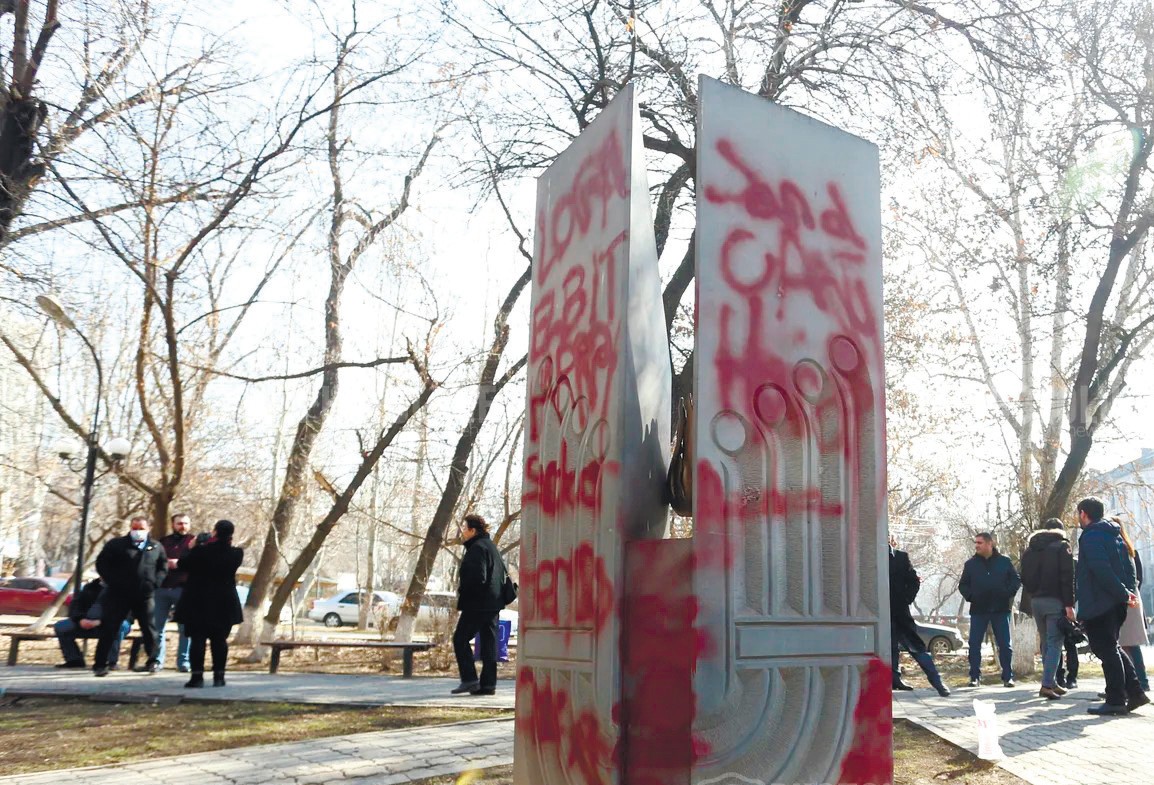
On 12 February 2021, the Holocaust memorial was desecrated once again. A few days later, vandals splashed red paint over the monument to Armenian-Israeli friendship, located in Yerevan’s Akhtanak Park.
Summing up, Shmulevich notes that the total number of acts of vandalism against the old and new Holocaust memorials amounts to at least twelve. However, no convictions have been handed down in connection with any of these incidents. Only in connection with the defacement of the memorial on 12 February 2021 was one person detained, having voluntarily presented himself to the police. Subsequently, criminal proceedings against him were discontinued on the grounds that, according to the official statement, he ‘co-operated with the investigation’ and expressed remorse.
From vandalism to attacks on a synagogue
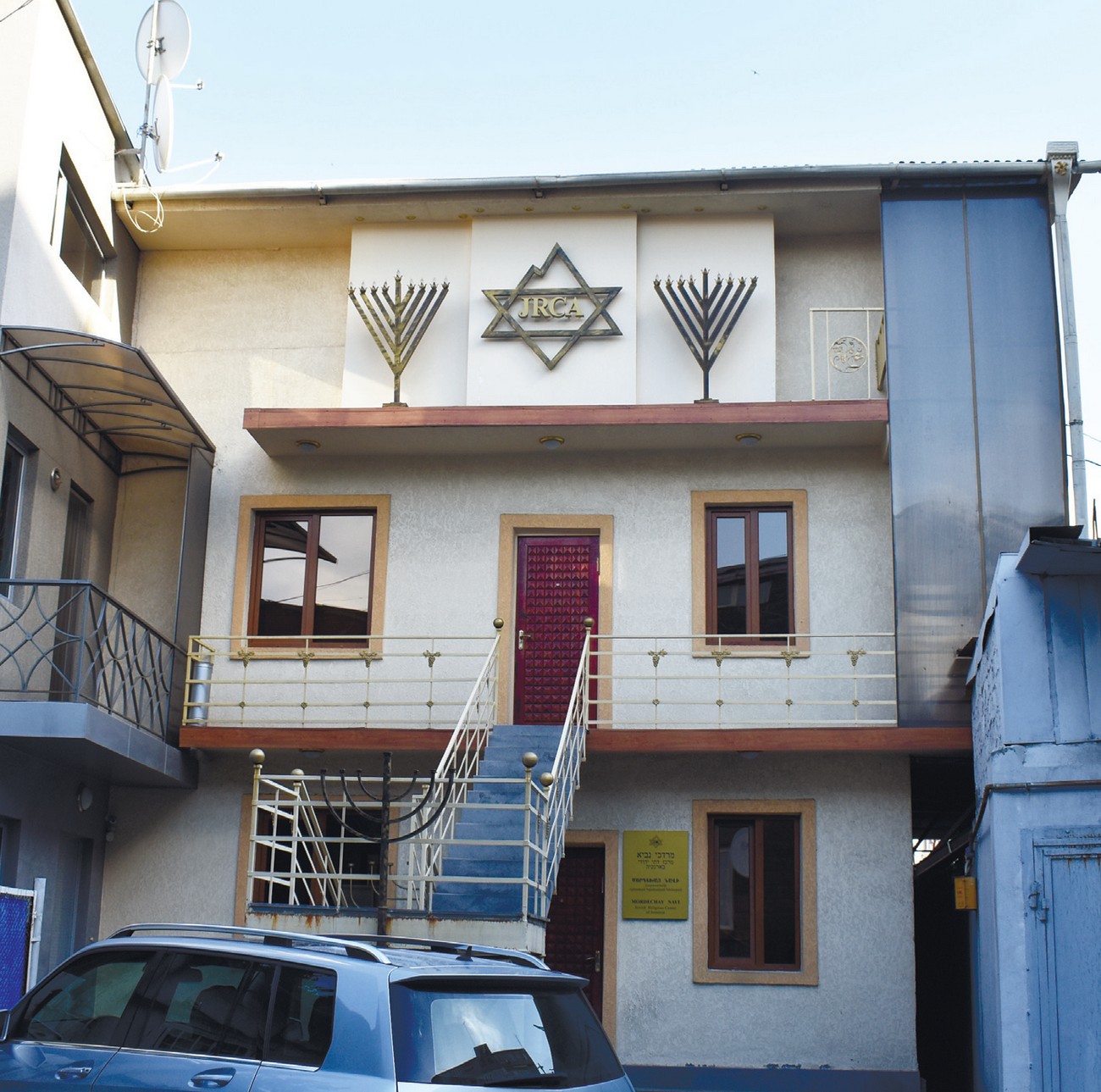
In previous years, the targets of such acts of vandalism were mainly memorials to the victims of the Holocaust. But following Azerbaijan's restoration of its territorial integrity, xenophobic incidents took on a new dimension. Their immediate target was Armenia's only synagogue—the Mordechai Navi Synagogue.
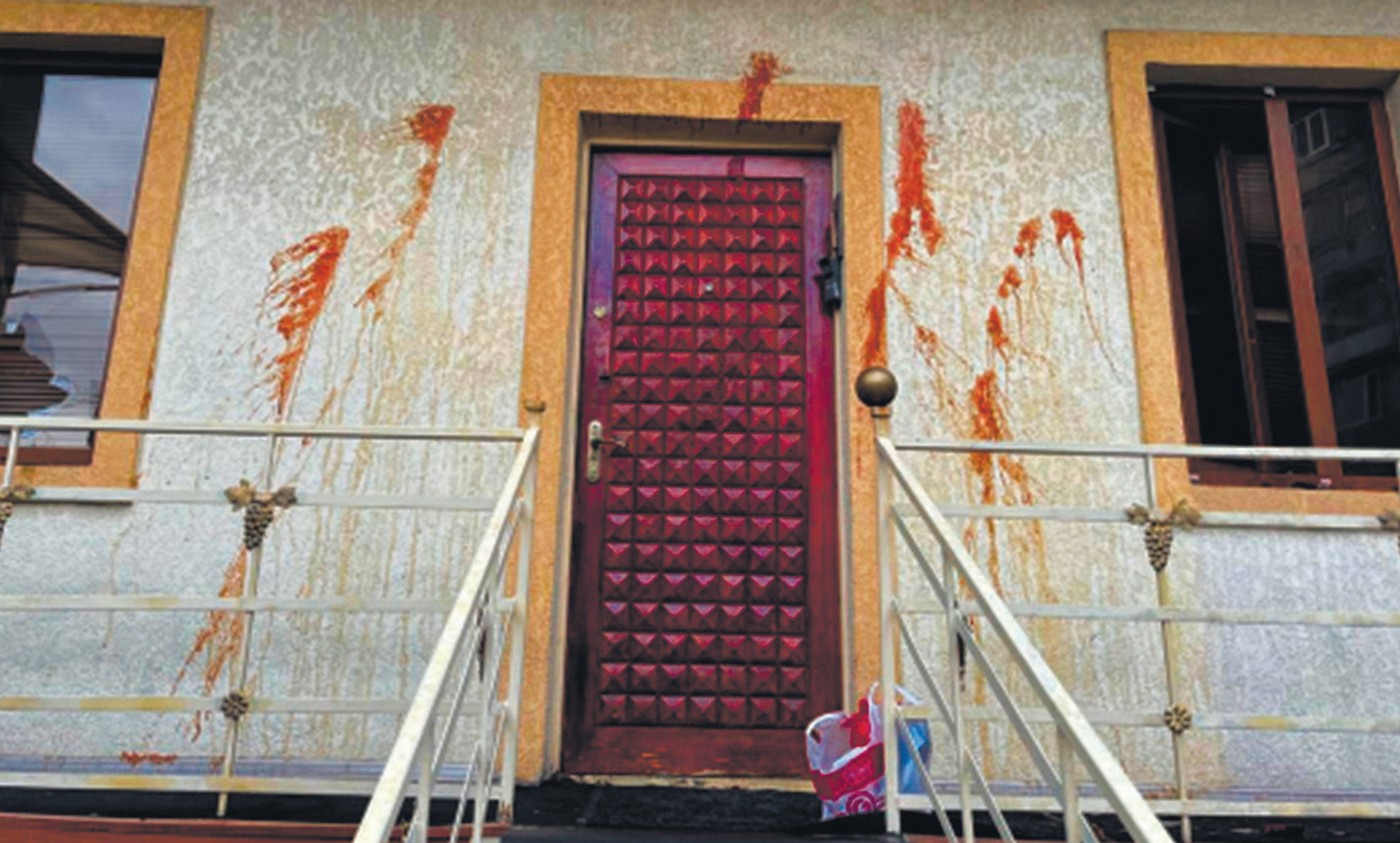
The first attack took place in September 2023. The second occurred on 3 October 2023, when the synagogue building was doused with red paint and its windows smashed. It is clear that this happened four days before the tragic events of 7 October in Israel. The group ASALA Young claimed responsibility for the attack, publishing a manifesto declaring Jews to be 'Armenia's sworn enemies'.
The manifesto stated that the incident on 3 October was 'only the beginning'. It also contained direct threats against rabbis and declarations of intent to wage war against Israeli Jews not only in Armenia, but also in Europe, the US, Canada and Georgia.
On 15 November 2023, the synagogue was attacked again. Unidentified individuals doused the building with petrol and attempted to set it alight. The same terrorist group announced that the next action against the Jewish community would take place outside Armenia—"in solidarity with the Palestinian and Lebanese resistance".
On 12 June 2024, the synagogue was subjected to yet another attack—the fourth in a series of incidents. A brick was thrown through the window.
In less than nine months, Armenia's only synagogue has been subjected to four acts of aggression. These were preceded by repeated acts of vandalism against memorials to the victims of the Holocaust in Yerevan over many years.
Anti-Semitism in public opinion
This chronicle is one-sided. The results of international sociological studies are no less revealing. In 2019, the American Pew Research Centre conducted a survey in Central and Eastern Europe. The survey focused on attitudes towards Jews.
The published results are clear: Armenia ranked first among the eighteen countries surveyed in terms of the level of negative perceptions of Jews. A full 32 per cent of those surveyed stated that they would not want to see Jews as citizens of their country.
Subsequent events suggest this figure is now significantly higher. The impression is clear: there are numerous acts of vandalism, attacks on Jewish sites and the public rhetoric of certain radical organisations.
Statistics alone do not explain the causes of what is happening. However, when combined with the facts set out above, they raise questions about the deeper roots of this hostility within Armenian society.
The roots of Armenian anti-Semitism
It is clear that one element of this ideological construct is the historical myths prevalent in Armenian nationalist circles. These include attempts to portray Jesus Christ as an Armenian, claims that Armenians were the first Christian people, and numerous alternative versions of history, cartography and the origins of ancient civilisations.
The mythologisation of the past is a clear sign of the historical exceptionalism of one's own people. It is also a sign of a strong conviction of a special right to make political and territorial claims.
Another component of this ideology is the glorification of political violence. For decades, the issue of the so-called 'genocide' has been accompanied by a widespread international campaign and attempts to justify the activities of Armenian terrorist organisations. The public consciousness has gradually transformed some of their members from criminals into 'fighters for the national cause'.
The rhetoric of certain representatives of Armenian society—both in Armenia itself and in the diaspora—clearly demonstrates how firmly the idea of achieving political goals through violence has taken root in the minds of some nationalist circles.
This raises legitimate questions. Who is killing one's own compatriots for refusing to make contributions to pan-Armenian funds? Who is carrying out ethnic cleansing in an attempt to rid the territories of 'Greater Armenia' of other nations? Who is trying to release terrorists who have carried out bombings at airports, embassies, on the underground, on trains, on sea ferries and at other civilian targets simply because they are Armenian and are regarded as national heroes?
Terrorism and the large-scale propagation of historical myths are now being used to shape perceptions of antiquity, exceptionalism and, consequently, special rights. Under this logic, anyone who does not share these views risks being categorised as an enemy.
In this particular instance, it's essential to acknowledge the inherent anti-Semitism, a component of a larger ideological framework.
Extremism, historical memory and the Jewish question
Professor Rovshan Mustafayev's book Passions for Virtuality (Tbilisi, 2006) published a list of 104 Jews who perished in 1918–1919 during the bloody events in the South Caucasus for the first time. The burial sites of the victims have been identified in the Guba district of Azerbaijan, where the mass killings took place. Today, a memorial complex commemorates the victims of the tragic events of 1918.
Mustafayev's research into the history of Armenian terrorism conclusively revealed that numerous Armenian nationalist organisations harboured covert agendas directed at the Jewish people. One of the incidents that caught his attention was the murder of Israeli athletes at the Munich Olympic Games on 5 September 1972. The Palestinian organisation 'Black September' was initially attributed with responsibility for the crime. However, in his writings, Mustafayev claimed that the operation was led by a terrorist of Armenian origin, Hakob Hakobyan (a native of Mosul), who later became one of the founders of the Armenian terrorist organisation ASALA.
This was confirmed in the book Death Marches. Crimes of the Armenian People against the Jewish People', published in Israel: 'Ten years later, the same Hakobyan (Bedros Oganesyan) established the international Armenian terrorist organisation ASALA, closely linked to the ideology of "Dashnaktsutyun".
ASALA was without doubt one of the most notorious Armenian terrorist organisations of the second half of the 20th century. Its activities were undeniably violent, including armed attacks, bombings and the assassination of diplomats and representatives of various states. In 1983, US President Ronald Reagan described ASALA as 'a barbaric, inhuman and, for a civilised society, unacceptable criminal organisation'.
Mustafayev also cites another incident linked to an attempted attack on Israel. On 11 May 2001, a few months before the 11 September terrorist attacks in the US, Israeli air defence forces shot down a Lebanese Cessna aircraft. The pilot, Stefan Oganes Nikolyan, an ethnic Armenian, was a kamikaze. Mustafayev states that Hezbollah's aim was to destroy an Israeli communications facility.
The figure of Garegin Nzhdeh—one of the most prominent figures of the 20th-century Armenian national movement—occupies a special place in the debate on historical memory. Nzhdeh's collaboration with Nazi Germany during the Second World War and his involvement in activities linked to German special units are undeniable facts. It is clear from the documents that he was implicated in Wehrmacht operations in Western Crimea.
A secret report by Sonderkommando 'Dromedar' No. 150, dated 2 January 1942, reported mass shootings of Jews, Karaites, Roma and other population groups in Crimea. The document stated: 'Simferopol, Yevpatoria, Alushta, Karasubazar, Kerch, Feodosia, as well as other areas of Western Crimea, have been cleared of Jews' (R. Mustafayev, Passions for Virtuality).
Another case concerns Drastamat Kanayan, known as Dro. Today, the Institute for National Strategic Studies of the Armenian Ministry of Defence bears his name. The study's data definitively shows that Dro collaborated with German organisations during the Second World War. The Austrian historian Erik Feigl definitively states that in December 1942, Dro met with Heinrich Himmler. 'Dro,' he writes, 'had the practice and experience of killing without feeling any pangs of conscience. This made a very strong impression on Himmler." In modern-day Armenia, Dro is still regarded by some sections of society as a national hero.
This contrast between the assessments of historical figures outside Armenia and their perception within the country remains one of the most contentious aspects of historical memory.
Concluding question…
An initiative for Israel to recognise the so-called 'Armenian genocide' will achieve nothing. It is capable of changing relations between the two peoples. A political decision taken over a hundred years later can undoubtedly influence today's sentiments and attitudes towards Jews.
History shows that international declarations do not change public consciousness. They may become a political symbol, but they cannot automatically dispel prejudices, historical myths or ideological attitudes that have taken shape over decades.
The 'Armenian genocide' issue is a subject of historical debate and an important element of the political identity of a section of the Armenian national movement. At the same time, there are parallel issues relating to the attitudes of certain members of Armenian society towards Jews, Israel and Jewish historical memory.
The traditional ties between the two peoples are particularly significant in this context. It is an irrefutable fact that relations between the Turkish and Jewish peoples have been predominantly friendly for many centuries. This is in stark contrast to the current political complexities between the states. It is clear that relations between Jews and Azerbaijanis also hold a special place. This is undoubtedly an example of centuries-long peaceful coexistence and mutual respect.
Temporary political disagreements between states must not lead to the interests and security of Jewish communities being sacrificed to those forces that use historical tragedies as a tool in political struggles.
Most importantly, we must ask: can the memory of past tragedies serve as a basis for reconciliation and dialogue, or will it continue to be used as a weapon against modern peoples and states?
RECOMMEND:
 175
175

