
A SERIOUS DILEMMA
Russia retains economic leverage, with the EU offering alternatives and Yerevan postponing inevitable decision
Author: Namig H. ALIYEV
The issue has already gone beyond an ordinary dispute over Yerevan's foreign-policy orientation: Armenia is becoming a site of competition between two different models of influence: Russian and European. However, at present, neither party has the capacity to determine Yerevan's choice entirely.
On 7 September, Dmitry Peskov, the Russian presidential press secretary, announced that Nikol Pashinyan, the Armenian Prime Minister, would visit Moscow "in the near future". On the same day, European Commission spokesperson Paula Pinho stated at a briefing in Brussels that the EC was not yet prepared to announce a specific timetable for introducing visa-free travel with Armenia. Concurrently, the European Union allocated an emergency financial assistance package of over €50 million to Armenia, with the aim of helping it to overcome the consequences of Russia's trade restrictions.
What are the most viable options for Armenia when it comes to offering Moscow and Brussels? With regard to the question of instruments of pressure, what options are available to Russia and the EU? It is important to establish the limits of their influence and to consider the feasibility of a European choice for Armenia.
Yerevan is moving closer to the European Union, while maintaining strong economic ties with Russia. Moscow is insisting that Armenia make a decision, Brussels is offering a prospect, and Yerevan is trying to buy time. The question therefore arises as to how long this balancing policy can continue.
Armenia is currently facing challenges that, in the past, would have been considered improbable. For decades, the country was regarded as one of Russia's closest allies in the South Caucasus. It is currently in the process of strengthening its ties with the European Union, with discussions underway regarding European integration and the adoption of legislation to initiate the process of joining the EU, while maintaining its membership of the Eurasian Economic Union.
Yerevan has not yet made a final decision. However, its political direction is already clear.
The question now is a different one: who has stronger leverage over Armenia—Moscow or Brussels? And can Yerevan genuinely replace one system of dependence with another?
A political signal, not membership
On March 26, 2025, Armenia’s National Assembly adopted the law “On the launch of the process of accession of the Republic of Armenia to the European Union”. It entered into force in April of the same year. Its key formula was expressed with complete clarity: Armenia “declares the launch of the accession process” to the European Union.
However, the adoption of the law did not make Armenia an EU candidate, let alone an EU member state. The law does not replace an official application for membership, negotiations with the European Union, the granting of candidate status, compliance with the Copenhagen criteria or the consent of all EU member states. This is fully understood in Yerevan itself. In March 2026, Nikol Pashinyan stated directly that, after the necessary conditions had been met, the EU would still have to take a political decision on admission.
In August 2026, the Armenian prime minister was already speaking about the next step—an official application to join the EU. According to Pashinyan, the application should be followed by an EU response and the creation of a roadmap. Only then, from the Armenian perspective, would a referendum on membership acquire substantive meaning.
The 2025 law should therefore be viewed primarily as a political decision to change the country’s strategic direction, rather than as a legal guarantee of European membership. This is where the main contradiction begins.
Dreaming of Europe while remaining in Eurasia
Yerevan understands perfectly well that membership of both the EU and the EAEU is impossible. Pashinyan has acknowledged this. At the same time, Armenia continues to benefit from the single Eurasian market.
According to figures cited by the Armenian prime minister in August, Armenia’s imports from EAEU countries amounted to approximately $5 billion in 2025, while Armenian exports to the EAEU market reached almost $3.2 billion. In other words, Yerevan is not yet prepared to abandon its existing economic structure in favour of a European future that is not guaranteed.
This is one of the main features of Armenia’s current policy: its political direction is moving faster than its economic reality.
Russia remains Armenia’s largest foreign economic partner. According to Armenia’s Foreign Ministry, Russian-Armenian trade reached $12.4 billion in 2024. Even if the structure of trade is changing, such dependence cannot be eliminated through a single parliamentary vote.
Russian leverage: economy, energy, market and EAEU
Russia's influence over Armenia has decreased significantly in comparison to that of ten or fifteen years ago. The political distance between the two countries has increased considerably. However, the weakening of political influence does not necessarily indicate a complete absence of material leverage.
The first instrument is trade. For a considerable period, the Russian market constituted the primary export destination for a broad spectrum of Armenian goods, encompassing agricultural products and alcoholic beverages. The second is energy. The Armenian economy has historically been closely tied to Russian energy resources and Russian businesses in this sector. Any significant restructuring of this system would require time and substantial investment.
The third instrument is remittances. The Russian direction is of great significance to Armenian households and to the economy as a whole. The World Bank has observed that in 2025, Russia accounted for 52% of the net inflow of personal remittances to Armenia.
The fourth is the EAEU. For Yerevan, this is not just a political organisation, but also a concrete economic mechanism that provides access to a significant market without customs barriers.
Russia's ability to influence Armenia's foreign policy is not based on its ability to order a change, but rather on the economic consequences of a premature and abrupt shift in policy. Moscow has already demonstrated its willingness to use this instrument. Restrictions have been imposed on a number of Armenian goods this year, which Yerevan viewed as contrary to EAEU rules. In July, Pashinyan made an appeal to Vladimir Putin to assist in the lifting of Russia's restrictions.
This episode provides a great deal of insight. It demonstrates that, even in the face of a significant political cooling of relations, Armenia remains obliged to consider the Russian market.
The issue put bluntly
Notwithstanding, the primary new element in Russia's policy is not trade but its demand for a referendum. In August, Russian Deputy Foreign Minister Mikhail Galuzin stated that Armenia should decide by December whether to hold a referendum on choosing between continued membership of the EAEU and accession to the EU. The Russian side has linked the issue to discussions about Armenia's future participation in Eurasian integration.
Moscow is shifting the discourse from the ambiguous concept of a "European course" to a specific option: either the EAEU or the EU.
This is a fundamentally new situation. As long as Yerevan maintains its position of seeking cooperation with both the EU and the EAEU, there remains flexibility in the situation. When selecting between two integration systems, the number of options is significantly reduced. Pashinyan's position on the matter is nuanced; while he does not reject the concept of a referendum, he is firmly opposed to the imposition of a deadline for its implementation.
The Armenian prime minister has asserted that it is imperative for there to be an official application to the EU, followed by a response from Brussels, a roadmap and an understanding of the real prospects for membership. It is imperative that the people exercise their democratic right to vote at the appropriate juncture.
Yerevan's logic is clear: it would be unreasonable to ask society to choose between a real EAEU and a hypothetical EU.
Russia in a hurry?
From one perspective, the passage of time is working in Armenia's favour; from another, it is working against Russia's position. As Yerevan builds stronger ties with the EU, it is establishing economic, political and institutional connections with European structures.
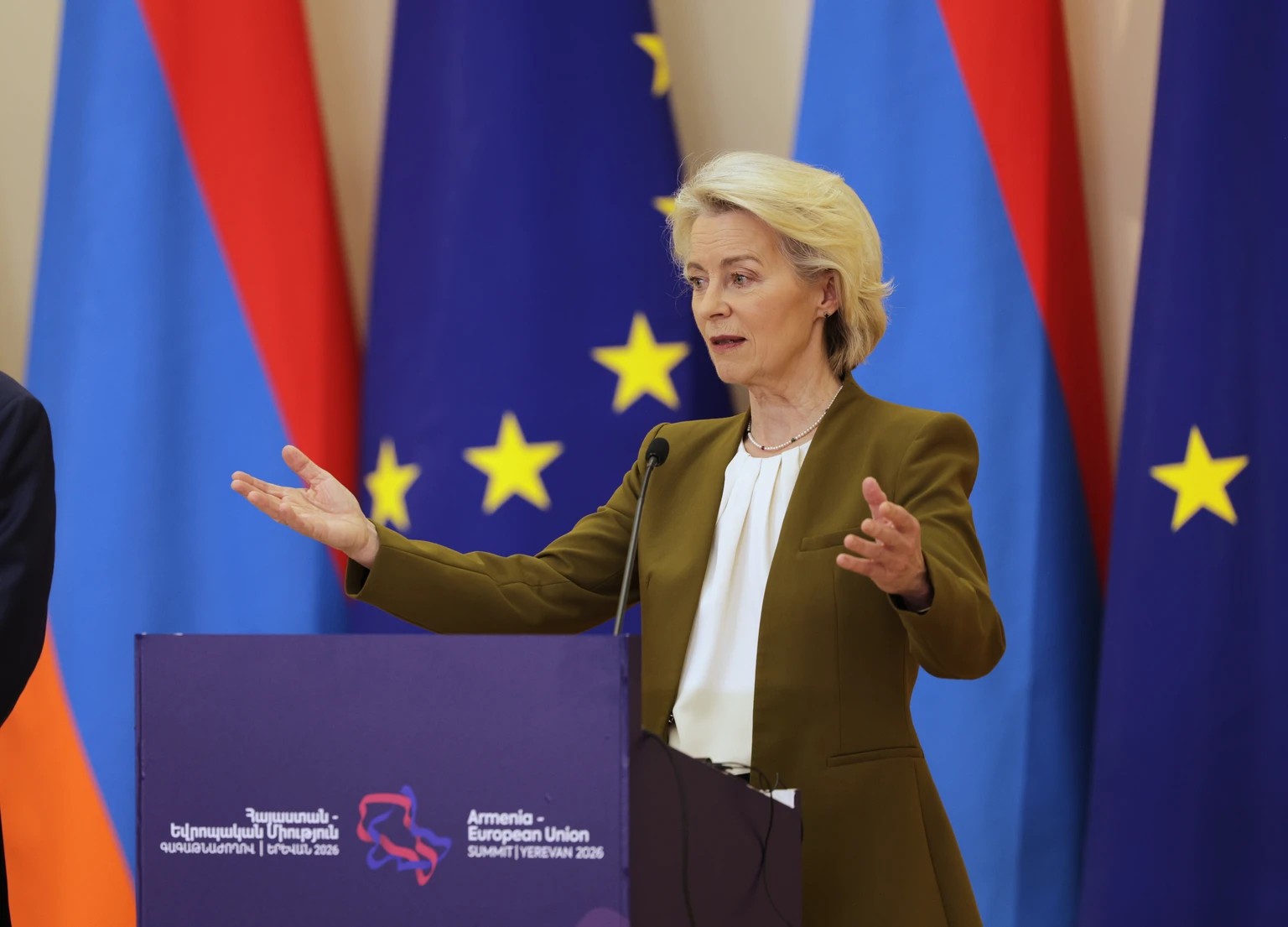
The inaugural EU-Armenia summit was convened in May 2026. Concurrently, Brussels is enhancing collaboration in the domains of the economy, energy, transport, digitalisation and security. Moscow is therefore interested in ensuring that the question of a strategic choice is considered before the European presence becomes an irreversible part of Armenia's economy and state apparatus. This underscores the need for a referendum.
What can Brussels realistically offer? This is where European policy encounters its own limitations. The EU is indeed offering Armenia much more than political statements. The European Union is Armenia’s largest donor. For 2024–2027, a €270 million Resilience and Growth Plan has been envisaged, while the total volume of investments mobilised in Armenia under the Global Gateway initiative is estimated at more than €2.5 billion.
The EU is offering Armenia:
1. investment;
2. the development of transport and digital infrastructure;
3. support for energy diversification;
4. public administration reform;
5. support for small and medium-sized businesses;
6. assistance with democratic and legal reforms;
7. wider access for Armenian businesses to the European market;
8. co-operation in the field of security;
9. the prospect of visa liberalisation.
In May, the EU and Armenia signed a connectivity partnership agreement providing for deeper co-operation in transport, energy and digitalisation.
This is where European leverage is gradually becoming more tangible. But Brussels is not promising Armenia rapid membership. This is a crucial point that is often pushed into the background in Armenia’s public discourse.
The European Union supports Armenia’s European choice but does not promise it automatic membership. Moreover, even the process of visa liberalisation has proved considerably more complicated than political statements might suggest. The EU-Armenia dialogue on visa liberalisation began in September 2024. In November 2025, the European Commission presented Armenia with a special action plan containing a broad range of requirements. These included document security, border management, migration and asylum, public order and security, and fundamental rights.
In other words, visa-free travel is not a political gift but the result of meeting a large number of technical and institutional conditions. Even after all the requirements have been fulfilled, the decision must still pass through the relevant European procedures.
Claims that Armenian citizens will “very soon” be able to travel freely within the Schengen area therefore do not reflect the actual state of affairs.
In August 2026, Pashinyan himself said that Yerevan expected to achieve visa liberalisation by 2029. Even Armenia’s leadership is therefore speaking not of the coming months but of a longer-term prospect.
Europe's economic response to Russia
Recent months have demonstrated that the EU is becoming not only a source of reforms and investment for Armenia but also a potential counterweight to Russian pressure.
On September 2, 2026, the Council of the EU agreed temporary trade-liberalisation measures for Armenian products. On 15 September, the European Parliament approved the European Commission's proposal to grant Armenia preferential trade conditions. The measures will remain in force for two years from the date on which the regulation enters into force and, according to Brussels, could cover 99% of Armenia's exports of fresh fruit, vegetables and plants to Russia, as well as more than 91% of its beverages and alcoholic drinks. This decision is linked to Russia's trade restrictions.
This is not merely symbolic diplomacy. Should Moscow decide to utilise its market access as a bargaining chip, Brussels is showing that it can offer an alternative market. This marks the beginning of a significant debate concerning Armenia's economic direction.
It is important to note that Russia cannot be replaced by Europe in the short term. The EU is offering Armenia opportunities for diversification, investment and integration, whereas Russia already provides Armenia with access to the functioning EAEU market, energy links, trade channels, labour migration and remittances.
Moscow is offering an existing system; Brussels is offering a prospect. These are two distinct categories of influence. It is in this context that Yerevan is currently pursuing a strategy of maintaining a provisional relationship with Moscow. Armenia's leadership characterises its strategy as "balanced" and "equidistant". Pashinyan has defined it as a transition from dependence on a small number of partners to a larger number of partners.
This is a rational strategy for a small state. But it has limits. It is feasible to maintain relations with both Moscow and Brussels, to a certain extent. Armenia has the option to maintain its membership of the EAEU while also cultivating trade relations with the EU. It can receive Russian energy resources and European investment. It can participate in Russian integration structures while reforming its legislation in line with European standards.
But at some point, a question arises: what will happen if the requirements of the two systems begin to contradict each other? That moment is already approaching. If Armenia genuinely submits an official application to join the EU and subsequently receives candidate status, the question of its continued membership of the EAEU will become unavoidable. Pashinyan himself acknowledges that simultaneous membership of the two integration organisations is impossible.
The conclusion is clear: Yerevan’s current policy is a deferred choice.
Between two models
A complicated process is underway. Moscow is trying to preserve the existing system of dependence and force Armenia to make a decision; the EU is seeking to create an alternative system of economic, institutional and political ties; and Yerevan is attempting to benefit from both systems for as long as possible.
The issue is that this balance is becoming increasingly unstable. Russia is already demanding a referendum, while European officials continue to speak of reforms and the fulfilment of specific criteria. Yerevan, for its part, wants to see a genuine European prospect first. The result is a distinctive triangle. Moscow has stated that a decision is required, while Brussels has outlined the conditions that must be met. Yerevan has requested a time extension.
The central question is not where Armenia will end up, but the price of its choice. The issue at hand is not merely a geopolitical question. At the end of the day, it all boils down to costs. It is evident that departing from the EAEU and substantially diminishing its economic relations with Russia would necessitate a considerable timeframe and substantial resources. Accession to the EU would require a comprehensive restructuring of legislation, the economy and state institutions.
The most probable short-term outcome is therefore not a sudden rupture, but a gradual withdrawal from the Russian integration system, accompanied by an acceleration of European integration. Moscow's insistence on Yerevan holding a referendum is a result of this ongoing situation.
Until a final decision is made, Armenia remains both a member of Russia's integration space and a state that has declared the start of its European path. At some point, however, it will need to decide which system—Russian or European—it considers to be more than a temporary partnership, but rather its long-term strategic interest.
Should a referendum be held, its implications would extend far beyond the question of EU membership. The vote will determine the future model for Armenia. As the moment of a genuine choice approaches, Yerevan will have fewer and fewer opportunities to continue its policy of ambiguity.
RECOMMEND:
 75
75