
EXPANSION ENERGY
SOCAR expands geographical footprint, building new international value chain
Author: Ilaha MAMMADLI
The oil and gas industry has evolved beyond the traditional "extract–process–sell" model. In the current business environment, every barrel of oil and cubic metre of gas is supported by a sophisticated system of assets. These include fields, pipelines, terminals, processing capacity, trading operations, financial instruments and technologies. The greater the number of links in this chain a company controls, the more resilient its position is in a changing energy market.
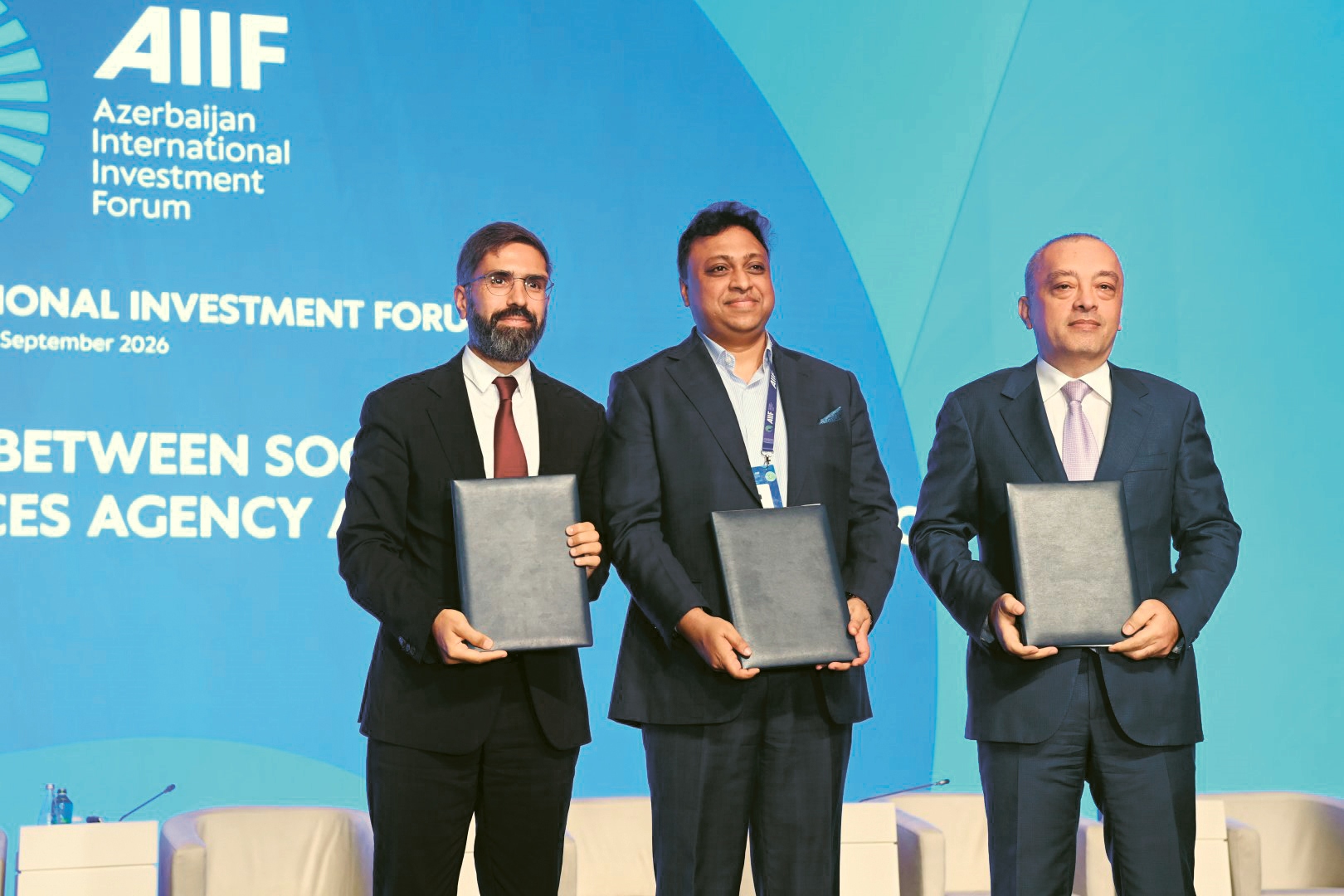
This is the direction in which the State Oil Company of Azerbaijan (SOCAR) is transforming. The documents signed and discussed at AIIF 2026 outlined a new geography for its interests, extending from the US and Africa to Central Asia and Europe.
A new production geography
SOCAR's business operations remain focused on upstream exploration and production. The company is now expanding its presence in this segment in both domestic and international markets. At AIIF 2026, SOCAR and the US company ExxonMobil signed a production-sharing agreement for the exploration, development and production of unconventional hydrocarbon resources in the Middle Kura Basin. The participating interests in the contract area are divided equally, at 50% each, with ExxonMobil serving as the project operator.
For the Azerbaijani side, the partnership provides access to unconventional-resource development technologies and an opportunity to combine its own knowledge of local geology with international experience.
A significant expansion into foreign markets is linked to the US company Comstock Resources. In accordance with a previously signed letter of intent, SOCAR will acquire a 20% interest in Comstock Legacy Haynesville's upstream assets, a 15% interest in Western Haynesville's upstream assets and a 15% interest in Comstock's stake in Pinnacle Gas Services LLC. The total value of the transaction, including standard purchase-price adjustments, will amount to $1.65 billion. SOCAR is therefore gaining direct access to US gas assets, while also obtaining an entry point into the international liquefied natural gas (LNG) trade.
The framework agreement on strategic partnership provides for an assessment of opportunities to sell outside the US LNG attributable to Comstock's share and produced from the Haynesville shale assets. The parties intend to identify potential buyers, assess pricing mechanisms and examine logistical and regulatory issues. SOCAR President Rovshan Naghiyev made the following statement: This partnership presents a valuable opportunity for SOCAR to expand its activities in the US energy market and diversify its business portfolio.
Africa has become another new direction. SOCAR and Italy’s Eni exchanged a protocol confirming the completion of a transaction for the acquisition of a 10% participating interest in the Baleine oil and gas development project in Côte d’Ivoire. Following completion of the transaction, the interests are distributed as follows: Eni—37.25%, Vitol—30%, Petroci—22.75% and SOCAR—10%.
This is the first major transaction giving the Azerbaijani company access to Africa’s upstream sector. Acquiring a stake in an operating project reduces initial risks and provides experience in a region with considerable resource potential but a complex infrastructure and regulatory environment.
Toghrul Kocharli, head of SOCAR’s International Business Development Department, expects the transaction to affect the country’s overall investment statistics as well: “In September, SOCAR’s acquisition of the asset in Côte d’Ivoire was completed. On this basis, I expect the data for 2026 to show a significant increase in Azerbaijan’s foreign direct investment in Africa—potentially reaching hundreds of millions of dollars.”
SOCAR does not view Baleine as a one-off investment but as a possible starting point for expanding its operations in West Africa, sub-Saharan Africa and North Africa.
Resources and routes
Another component of the strategy is to turn transport and trading infrastructure into independent sources of revenue. In Central Asia, SOCAR does not necessarily need to own a field to participate in the value created. It can provide producers with access to international markets. SOCAR Trading already ships Uzbek naphtha towards Black Sea ports, and the company is now examining the possibility of exporting Uzbek-produced diesel fuel through SOCAR’s terminal in Kulevi.
“At present, SOCAR Trading ships naphtha from Uzbekistan and delivers it to Black Sea ports. The product under consideration is diesel—the diesel fuel produced in Uzbekistan. If we reach an agreement, it will also be exported through our terminal in Kulevi,” said Kocharli.
Jonathan Barr, managing director of Apollo Global Management, summarised Azerbaijan’s importance to the region succinctly: “Azerbaijan effectively serves as a gateway to Central Asia.”
According to him, Kazakhstan, Uzbekistan and Turkmenistan possess significant natural resources, but their access to international markets differs from Azerbaijan’s. Apollo is considering the expansion of pipeline infrastructure, investment in railways and processing capacity. For SOCAR, this opens up prospects for participating not only in production and trading but also in the infrastructure facilitating the movement of regional cargoes.
International expansion is not, however, pushing the national resource base into the background. SOCAR, XRG and TotalEnergies exchanged the Final Investment Decision for the full-scale development of the Absheron gas-condensate field. The first phase is already supplying approximately 1.5 billion cubic metres of gas a year, while the second is expected to increase production to at least 4.5 billion cubic metres. Bassem Tadros, XRG’s senior vice-president for asset management, said: “We are working closely on this project with the State Oil Company of Azerbaijan and TotalEnergies to bring it to the Final Investment Decision stage, with an investment value of several billion dollars.”
The second phase is important not only because it will increase production. Part of the gas will be exported to Türkiye, while another portion will be supplied to Azerbaijan’s domestic market. The condensate will be exported through the Baku–Tbilisi–Ceyhan oil pipeline.
Absheron therefore addresses two objectives at once: strengthening the domestic resource base and creating additional export opportunities.
Long-term capital
Expanding the production portfolio and building infrastructure require substantial resources over an extended period. Financial partnerships are consequently becoming an independent component of SOCAR’s strategy. The memorandum with Apollo provides for an assessment of possible investments by funds managed by the company in SOCAR’s upstream interests. Financing for energy projects and alternative funding mechanisms were discussed with Citigroup, while talks with Brookfield Asset Management covered energy infrastructure, renewable energy and new financial opportunities.
“Creating long-term value in the energy sector requires partnerships that bring together global investment experience, advanced technologies and expertise,” Rovshan Naghiyev said after meeting Brookfield’s management.
The need for long-term capital is particularly acute in renewable energy. According to Elmir Musayev, chief executive of SOCAR Green, such projects require financing for 15–20 years, whereas commercial banks are not always prepared to provide funding for such a long period. “In our view, it is very important for local banks to play a more active role, particularly by providing long-term financing in the national currency,” he said.
Manat-denominated financing is also important for managing currency risk. Project revenues may be generated in the national currency, while a significant portion of equipment and borrowed funds is denominated in US dollars. Alongside local banks, international financial institutions can play a key role in this area. SOCAR Green is also considering industrial enterprises as the principal buyers of green electricity. Direct supplies to such consumers would allow renewable generation to expand while reducing the carbon footprint of the most energy-intensive industries.
A reassessment is also taking place in the field of decarbonisation. For an oil and gas company, reducing methane emissions is not merely an environmental obligation but also a way of returning lost raw material to the production cycle. Hikmet Abdullayev, SOCAR’s deputy vice-president, said that the company intends to bring emissions monitoring fully in-house. Foreign specialists were initially involved in this work. “At every stage of the methane-emissions reduction process—from on-site measurements to analysis—we brought in foreign experts, while simultaneously including staff-training obligations in the contracts,” Abdullayev added. Reducing methane emissions also pays for itself by returning the raw material to the system.
The same logic underlies the programme to decommission and preserve thousands of Soviet-era wells. At accessible sites, work takes approximately one month once the necessary permits have been obtained. Technically complex locations, however, require imported equipment, additional assessments and underwater surveys.
The digital link
Concurrently, SOCAR is integrating conventional gas trading with the impending energy transition. It is anticipated that cooperation with Germany's SEFE will develop in the following areas: natural gas and LNG, energy infrastructure, upstream investment and security of supply. The agreements with VNG encompass natural gas, infrastructure, and regulatory matters, as well as hydrogen and its derivatives. Existing gas links are therefore gradually creating a basis for partnerships in the next energy cycle.
Digital infrastructure is part of the same structure. Caspian Mind AI will become the operator of the Oracle Alloy platform in Azerbaijan and will be able to provide locally managed Oracle cloud services. Given the energy industry's extensive use of data in exploration, drilling, equipment monitoring, emissions control and production forecasting, this creates a foundation for wider use of cloud technologies, analytics and artificial intelligence.
While the agreements reached at AIIF 2026 may appear to be a collection of unrelated projects, they are in fact interconnected by a common economic logic. SOCAR is expanding its production portfolio in Azerbaijan, the US and Africa; increasing its trading in gas, LNG and petroleum products; using terminals and routes as independent assets; attracting global capital; and investing simultaneously in renewable energy, decarbonisation and digital solutions.
Resources remain the foundation of the business, but the majority of value is now being generated along a longer chain, from the field and financing to logistics, trading and technology.
For Azerbaijan, this means a gradual shift from predominantly exporting its own energy resources towards a model in which revenue is also generated by foreign assets, regional routes and international partnerships. The primary indicator of SOCAR's transformation is therefore no longer solely its production volume, but also the company's ability to extend Azerbaijan's energy map far beyond the Caspian.
RECOMMEND:
 33